

Watching a parent or grandparent start to lose their footing is one of those quiet moments that changes how a family thinks about safety. Maybe it’s a stumble on the stairs, a hesitation crossing the kitchen, or a fall that thankfully wasn’t serious — but easily could have been. For many families, that moment is when walking aids for elderly adults first come up in conversation.
The good news is that today’s mobility devices have come a long way from the clunky, institutional-looking equipment many people picture. Modern canes, walkers, and rollators are designed to support real, active lives — helping older adults stay steady on their feet, move through their day with more confidence, and hold on to the independence that matters so much to them.
This guide walks through the main types of walking aids for seniors, what each one is good for, and how to think through choosing the right one for a specific person’s needs. It’s meant as general education, not medical advice — more on that below.
What Are Walking Aids for Elderly Adults?
Walking aids for elderly adults are mobility devices — such as canes, walkers, and rollators — that provide extra balance, support, and stability while standing or walking. They’re typically considered when someone experiences reduced strength, balance difficulties, joint pain, recovery from surgery or injury, or a general decline in walking confidence that comes with age.
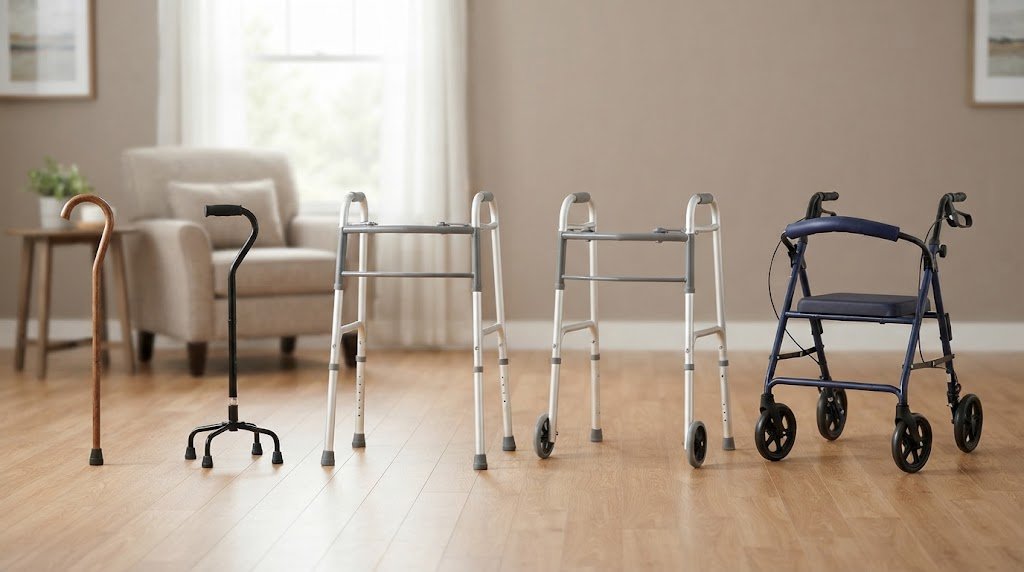
Someone might start exploring mobility aids for seniors after a fall, following a hip or knee surgery, because of a condition like arthritis or Parkinson’s, or simply because walking has started to feel less steady than it used to. There’s no single “right time” — it often comes down to how a person feels moving through their day, and what a doctor or physical therapist observes during a checkup.
Types of Walking Aids for Seniors
Not all walking aids serve the same purpose. Some offer light, occasional support; others provide substantial weight-bearing assistance. Here’s a closer look at the main categories.
Standard Canes
A standard cane is a single straight pole, usually with a curved or offset handle, that offers light balance support on one side of the body.
- Who it may be suitable for: People with mild balance concerns or slight weakness on one side who don’t need major weight support.
- Main benefits: Lightweight, affordable, easy to carry, and unobtrusive.
- Limitations: Offers minimal support and can be less stable on uneven ground.
- Stability/support level: Low.
Quad Canes
A quad cane has a four-legged base instead of a single tip, giving it a wider, more stable footprint.
- Who it may be suitable for: Those who need more support than a standard cane provides, including people recovering from a stroke.
- Main benefits: Stands upright on its own and offers more side-to-side stability.
- Limitations: Bulkier and heavier than a standard cane; can be awkward on stairs.
- Stability/support level: Moderate.
Walking Sticks
Often used interchangeably with canes, walking sticks for seniors are typically simpler, sometimes wooden, single-point supports.
- Who it may be suitable for: Active older adults who want light support during walks or hikes rather than everyday mobility assistance.
- Main benefits: Simple, sturdy, often stylish.
- Limitations: Minimal support for those with real balance concerns.
- Stability/support level: Low.
Standard Walkers
A standard walker has four rubber-tipped legs and no wheels, requiring the user to lift and place it with each step.
- Who it may be suitable for: People who need significant support and can safely lift the device.
- Main benefits: High stability; good for those with considerable weakness or balance issues.
- Limitations: Slower to use; not ideal for people who tire easily or lack upper body strength.
- Stability/support level: High.
Two-Wheel Walkers
These walkers have two front wheels and two stationary rear legs, offering a middle ground between a standard walker and a rollator.
- Who it may be suitable for: People who need strong support but find lifting a standard walker tiring.
- Main benefits: Easier to move than a standard walker while still offering solid stability.
- Limitations: Less maneuverable than four-wheel rollators.
- Stability/support level: High.
Rollators
Rollators for seniors are walkers with three or four wheels, hand brakes, and often a built-in seat.
- Who it may be suitable for: Older adults who can walk without needing to lean heavily on the device but want support, along with a place to rest.
- Main benefits: Smooth movement, built-in seat for resting, storage basket, brakes for control.
- Limitations: Not ideal for people who need to put significant weight on the device, since it can roll away if not braked.
- Stability/support level: Moderate to high, depending on the model and how it’s used.
Forearm/Elbow Crutches
These crutches include a cuff that wraps around the forearm, distributing support beyond just the hand and wrist.
- Who it may be suitable for: People with long-term mobility needs who still have good upper body strength and coordination, often used for chronic conditions rather than typical age-related balance decline.
- Main benefits: Frees the hand slightly and reduces strain compared to underarm crutches.
- Limitations: Requires more coordination and strength than a standard walker.
- Stability/support level: Moderate.
Specialized Mobility Aids
This category includes devices like hemi-walkers (one-sided walkers), platform walkers for those with limited hand grip, and knee scooters for temporary injuries.
- Who it may be suitable for: People with specific conditions, such as one-sided weakness or a lower-leg injury, where a standard device doesn’t fit their needs.
- Main benefits: Tailored to unique physical limitations.
- Limitations: Often require guidance from a therapist to select and use correctly.
- Stability/support level: Varies by device.
Walking Aids for Elderly: Benefits
When matched to the right person and used correctly, walking aids for elderly adults can offer real, everyday advantages:

- Improved stability while standing, turning, and walking on different surfaces.
- Increased confidence, which often leads to people staying more active rather than avoiding movement out of fear.
- Support with balance, especially helpful for those with inner ear issues, neuropathy, or muscle weakness.
- Greater independence, allowing more errands, outings, and daily tasks to be done without relying on another person.
- Reduced risk of falls when properly fitted and used correctly — though it’s important to understand that no device can guarantee a fall won’t happen. A poorly fitted or misused walking aid can even increase risk.
- Easier movement around the home and outdoors, from the kitchen to the mailbox to a walk around the block.
How to Choose the Right Walking Aid
There’s no one-size-fits-all answer here. The right choice depends on a combination of physical needs and lifestyle factors:

- Balance ability — mild unsteadiness versus significant balance impairment call for very different levels of support.
- Strength — some devices require more upper body strength and coordination than others.
- Weight-bearing needs — a person recovering from hip or knee surgery may need to keep weight off one leg, which affects the device choice.
- Walking environment — mostly flat indoor floors versus uneven sidewalks, grass, or curbs.
- Indoor vs. outdoor use — some walkers maneuver beautifully indoors but struggle outside, and vice versa.
- Portability — whether the device needs to fold for car trips or travel.
- Height and adjustability — most canes, walkers, and rollators should be adjustable to the user’s height.
- Weight capacity — every device has a maximum weight limit that should be checked.
- Wheels and brakes — wheels ease movement but require good hand control to use brakes safely.
- Seat availability — helpful for anyone who tires easily or needs to rest during outings.
- Grip comfort — especially important for those with arthritis or reduced hand strength.
- Storage and transportation — how easily it fits in a car trunk, closet, or on public transit.
Cane vs. Walker vs. Rollator
| Feature | Cane | Walker | Rollator |
|---|---|---|---|
| Support level | Low | High | Moderate to high |
| Stability | Moderate | High | Moderate to high |
| Ease of movement | Very easy | Slower, requires lifting | Easy, rolls smoothly |
| Portability | Very portable | Moderate (often folds) | Moderate (often folds) |
| Best use case | Mild balance support | Significant support needs | Moderate support with need to rest |
| Usually has wheels? | No | No (some models have front wheels) | Yes |
| Usually has a seat? | No | No | Yes |
This table offers a general starting point. A physical therapist or doctor can help determine which category — and which specific model — fits a person’s actual needs.
How to Make Sure a Walking Aid Fits Properly
A poorly fitted walking aid can do more harm than good, so proper fit really matters.
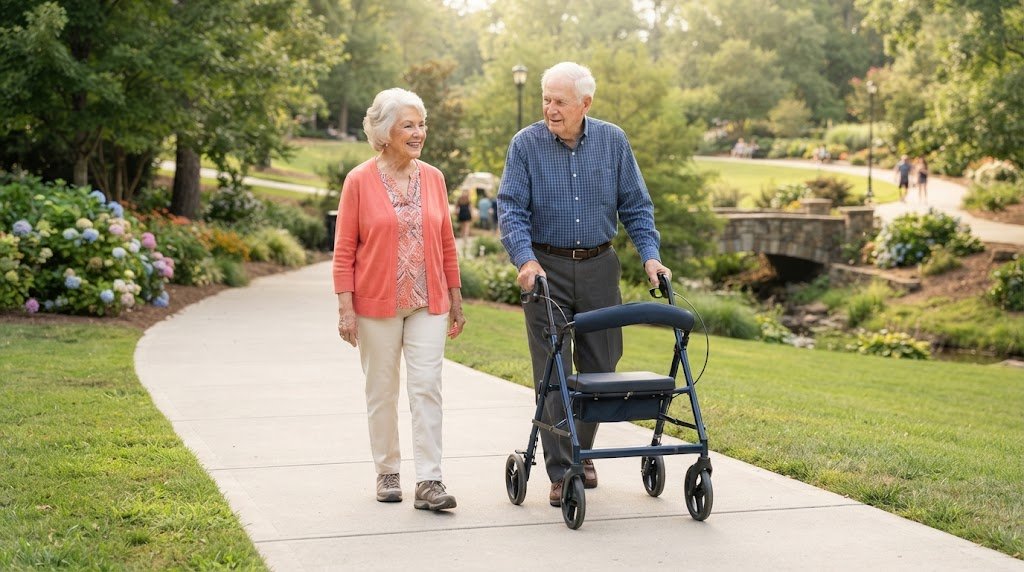
Handle height is the most common adjustment point. As a general rule, the top of a cane, walker, or rollator should line up with the crease of the wrist when the arm hangs relaxed at the side. When gripping the handle, the elbow should bend slightly — around 15 to 20 degrees — rather than locking straight or bending sharply.
Posture matters just as much as height. The user should stand upright, looking forward rather than down at their feet, with the device positioned close to the body rather than out in front. Leaning too far forward over a walker is a common issue that can actually throw off balance rather than improve it.
Because fit affects both comfort and safety, it’s worth consulting a physical therapist, occupational therapist, or doctor when selecting and adjusting a walking aid — especially for someone with more complex mobility needs.
Common Mistakes Seniors Make When Using Walking Aids
Even a well-chosen device can become a safety risk if it’s used incorrectly. Common issues include:
- Incorrect height — too tall or too short, straining the shoulders, wrists, or back.
- Using a device with too little support — for example, sticking with a cane when a walker is really needed.
- Walking too quickly, outpacing the stability the device can offer.
- Poor footwear, such as loose slippers or shoes without good traction.
- Not maintaining brakes or wheels, which can wear down or stick over time.
- Carrying unsafe loads, like bags hung on walker handles that throw off balance.
- Using a walker incorrectly on stairs — most standard walkers and rollators aren’t designed for stairs at all.
- Ignoring pain, dizziness, weakness, or worsening balance instead of mentioning it to a doctor.
Safety Tips for Using Walking Aids
A few home and lifestyle adjustments go a long way toward making walking aids more effective:
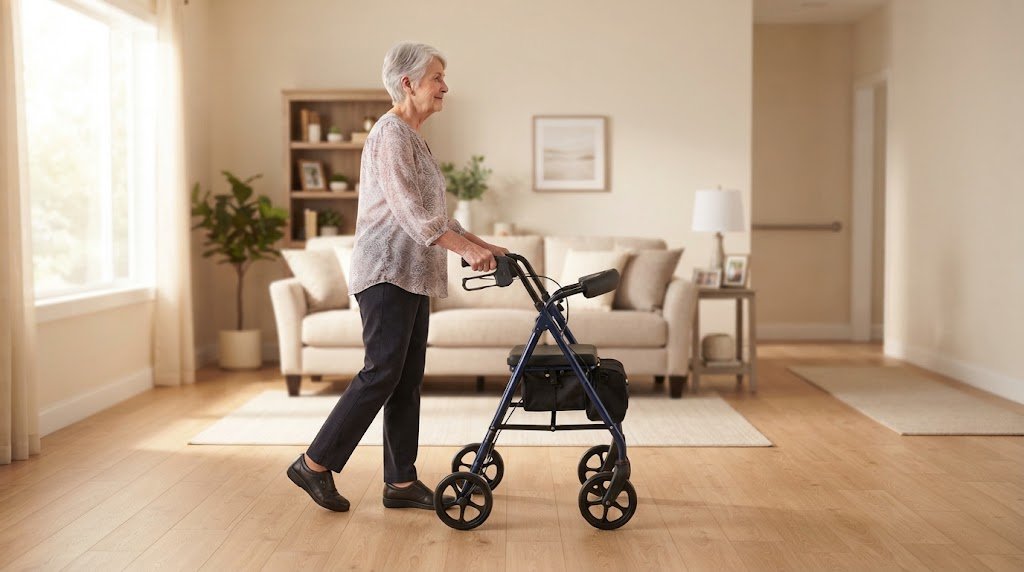
- Remove loose rugs and clutter from walking paths.
- Improve lighting in hallways, stairwells, and entryways.
- Keep walkways clear of cords, furniture edges, and pet items.
- Use supportive, well-fitting footwear rather than slippers or socks alone.
- Regularly check rubber tips and wheels for wear.
- Always lock rollator brakes before sitting down.
- Avoid using wheeled walkers or rollators as stair-climbing devices — use handrails or a different strategy for stairs.
When Should an Elderly Person Consider a Walking Aid?
There’s rarely one dramatic sign — it’s usually a pattern that builds over time. Some common indicators include:
- Frequent loss of balance, even briefly
- Feeling unstable or unsure while walking
- Difficulty standing or walking for extended periods
- A recent fall, or a near-fall that felt too close for comfort
- Noticeable weakness in the legs or overall fatigue while walking
- Difficulty walking outdoors on uneven ground, curbs, or inclines
Any sudden change in walking ability — especially if it happens quickly — should be discussed with a doctor rather than assumed to be a normal part of aging. Sudden changes can sometimes point to an underlying issue that deserves medical attention.
Frequently Asked Questions
What is the best walking aid for an elderly person? There isn’t one best walking aid for every elderly person — it depends on individual balance, strength, and mobility needs. A doctor or physical therapist can help match the right type of device to the right person.
Is a cane or walker better for seniors? It depends on the level of support needed. A cane offers light balance assistance, while a walker provides much more substantial support. Someone with significant balance or strength concerns typically needs a walker rather than a cane.
What is the safest walker for elderly adults? The safest walker is one that’s properly fitted, appropriately sized for the person’s strength and balance level, and used correctly. Features like adjustable height, sturdy brakes (for rollators), and a comfortable grip all contribute to safe use.
Are rollators good for seniors? Rollators for seniors can be a great option for those who need moderate support and want a seat to rest on during outings. They’re generally best for people who don’t need to lean heavily on the device, since rollators can roll if brakes aren’t used properly.
How do I know if my elderly parent needs a walker? Signs can include frequent unsteadiness, a recent fall, visible fatigue while walking, or hesitation moving around the house. A conversation with their doctor or a physical therapy evaluation can offer a clearer answer.
Should a walker have wheels? It depends on the person’s strength and coordination. Wheeled walkers are easier to move but require good hand control for the brakes. Walkers without wheels offer more stability but require the strength to lift them with each step.
How high should a walker be? As a general guideline, the handles should line up with the crease of the wrist when standing with arms relaxed at the sides, allowing a slight bend in the elbow when gripping the handles.
Can elderly people use walkers outside? Yes, many walkers and rollators are designed for outdoor use, though surface type matters. Larger wheels tend to handle uneven sidewalks and outdoor terrain better than smaller ones.
What is the difference between a walker and a rollator? A standard walker has no wheels and must be lifted with each step, offering maximum stability. A rollator has wheels and brakes, allowing it to roll instead of being lifted, along with typically including a built-in seat.
Does Medicare cover walking aids? Medicare Part B may cover walkers, rollators, and canes as durable medical equipment when prescribed by a doctor and deemed medically necessary, though coverage details, costs, and supplier requirements can vary. It’s best to confirm specifics directly with Medicare or a healthcare provider.
CDC – Preventing Falls and Hip Fractures
Conclusion
Choosing the right walking aid for elderly adults isn’t about picking the most popular or expensive option — it’s about matching the device to the person’s actual balance, strength, mobility needs, and daily environment. A cane might be all one person needs, while another benefits far more from a rollator with a seat and brakes. What matters most is an honest look at how someone is really moving through their day, paired with guidance from a doctor or physical therapist when balance concerns, weakness, or recent falls are part of the picture.
With the right support — and the right device — many older adults find that walking aids don’t take away independence. They help protect it.
This article is intended for general educational purposes only and is not a substitute for professional medical advice. Please consult a doctor, physical therapist, or occupational therapist for guidance specific to your situation or a loved one’s needs.