
Table of Contents
- Introduction
- Understanding Mobility Challenges for U.S. Seniors
- Why Mobility Solutions Matter
- Types of Mobility Solutions for U.S. Seniors
- Choosing the Right Mobility Solution
- How Caregivers Can Support Senior Mobility
- Maintaining Mobility Equipment
- Frequently Asked Questions
- Conclusion

Introduction
Growing old in the USA does not have to mean that a person should sacrifice his or her right to go out and enjoy the independence of doing whatever they want to on their own. Whether it be a walk around the block, visit to the doctor’s, or sitting down in the local shopping center, mobility is what makes elderly people independent and happy.
However, unfortunately, many elderly people in America find it increasingly harder to move with time. They suffer from joint pains, loss of coordination and balance, and simply such acts as rising from a chair and moving in parking lots are becoming dangerous for them. Thankfully, there are many ways today that help elderly Americans stay mobile, comfortable and safe.
This manual explains the types of mobility devices that are used by American seniors the most, their target audience, and how to help the senior lead an independent life using them.
Understanding Mobility Challenges for U.S. Seniors
The problem of mobility problems usually comes gradually, and this is one of the reasons why they remain unseen for quite a long time until a person faces a fall or other problem.

The common reasons that lead to mobility problems of seniors in the USA are:
Arthritis and joint problems, making walking, standing, and going up and down the stairs difficult
Problems with balance and the inner ear that increase the risk of falling
Weakness of muscles associated with inactivity and recovery from illnesses
Neurological diseases like Parkinson’s disease or the consequences of a stroke
Problems with vision that influence one’s ability to navigate the stairs, curbs, and other obstacles
Chronic conditions like diabetes and cardiovascular diseases that make someone less active
Falls remain especially dangerous for older people. They remain one of the main sources of injuries in the United States, and the risk of falling leads to another problem – the problem of being afraid of falling. Some seniors avoid many things they would do if not for this reason, but identifying these problems at the earlier stage allows finding the appropriate solution.
Why Mobility Solutions Matter?
There’s a reason why mobility solutions are important – it’s because mobility is directly linked to independence, self-confidence, and overall wellbeing.
When older individuals have mobility solutions to rely on, they’re more able to:
Remain social with their friends, relatives, and community at large
Continue attending all medical appointments independently of assistance from others
Spend time in community parks or walking around their neighborhood
Remain physically fit by moving around each day
Be self-confident and not afraid of being anxious in day-to-day life
Alternatively, having limited mobility may result in loneliness, lack of physical activity that leads to deconditioning of muscles, and decreased mental wellbeing. This is why having mobility solutions is not about giving anything up but about continuing to be independent in an appropriate way.
Types of Mobility Solutions for U.S. Seniors
There’s no single mobility aid that works for everyone. The right choice depends on strength, balance, the environments a person moves through, and any underlying medical conditions. Here’s an overview of the main categories of senior mobility solutions available in the United States.
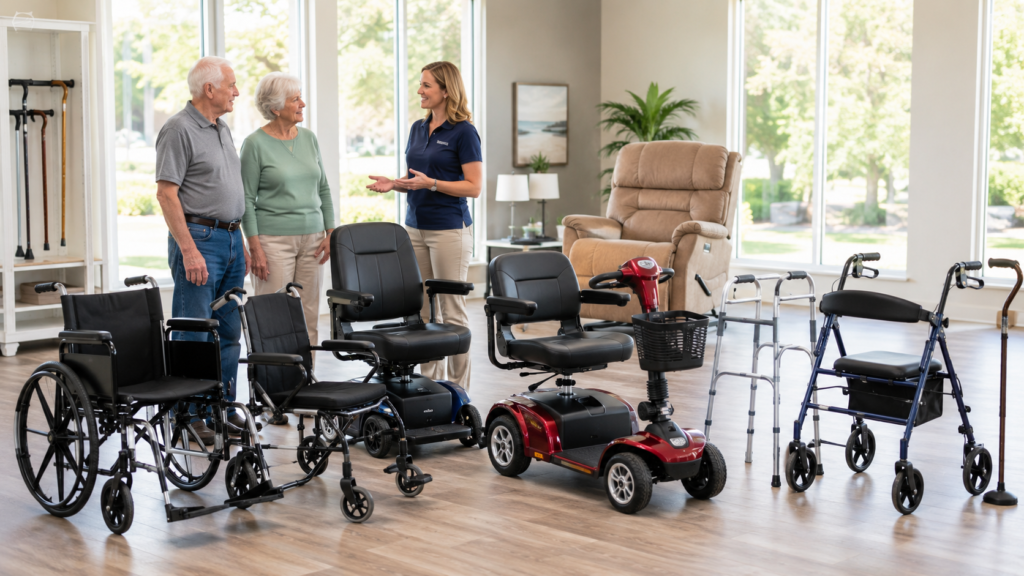
Mobility device can be used effectively by all individuals due to their strength levels, balance, surroundings, and medical issues that they might suffer from. Below is a summary of the various types of mobility solutions for seniors that are available in the US.
Wheelchairs
Among the best known mobility solutions are wheelchairs that come in many designs depending on individual needs and level of independence.
Manual wheelchairs rely on the user’s energy or are simply pushed by a caregiver and may work well for someone who has upper body strength but cannot walk long distances.
Transport wheelchairs are light in weight and are meant to be pushed by a caregiver and are useful when traveling to a hospital, airport, or during excursions where there is company around.
Power-operated wheelchairs have a battery-driven motor that enables those people who lack strength in arms and legs to move independently in their surroundings.
There are different wheelchairs for each function and therefore discussion with a healthcare professional is necessary.
Mobility Scooters
There are mobility scooters which provide easier transport seating over distances rather than the distance walked.
The folding type of mobility scooter can be stored in the boot of a car and will prove helpful for senior citizens when traveling or need some assistance in mobility.
The 3-wheeled mobility scooters are more maneuverable and are suitable to use in smaller spaces.
The 4-wheeled mobility scooters are stable and are used by senior citizens outdoors at public parks and housing societies.
The scooters are ideal for those senior citizens who have controlled trunk movement and difficulty in walking long distances.
Walkers
Walkers offer the user a stable platform for seniors when the level of assistance required is greater than that offered by a cane but less than the seated apparatus.
Standard walkers are extremely lightweight structures, and hence they must be picked up by the user while walking and offer the most amount of stability.
The knee walker is an aid for those patients who have had recent injuries in their foot, ankle, or leg; they allow the patient to rest his/her knee on the cushioned area while walking.
Walkers are of great help to seniors recovering from surgery, balance issues, and post-hospitalization period.
Walking Canes
Walking canes are commonly the first mobility aid an individual will turn to for many reasons; walking canes are simple, portable and useful for various types of day-to-day mobility problems.
Benefits: Older individuals suffering from slight balance problems or mild joint pain or minor injuries will benefit immensely from using walking canes.
Everyday use: Canes are convenient to carry around when going to doctor visits, stores or taking a walk down the street without being cumbersome like other devices.
Reasons why walking canes are helpful: They are light, cheap to maintain and have different kinds of handles based on height and grip strength.
Lift Chairs
A lift chair is similar to a common comfortable chair but has an electrical device that enables the user to tilt and elevate the seat, hence making it easier for them to get out of the seat without straining in their knees, hips, or back.
How they work: The user simply needs to press a button and the chair will automatically tilt and elevate to help the user get out of the seat and after that lower to enable the user to get back into the seat.
Benefits: It reduces the likelihood of falling as one tries to get out of a regular chair that has low elevation and reduces joint pain among arthritic patients.
Target group: It is particularly useful for older adults having difficulties with hips or knees, patients having a surgical procedure done or individuals finding it difficult getting out of a regular chair.
Rollators
Rollators offer more convenience to their users as compared to the traditional walkers due to additional comfort features.
The standard rollator walkers usually have wheels, hand brakes, and seats which allow the user to sit when required during walking.
The upright rollators feature a higher height and the forearm support that ensures good posture and less pressure on the wrist and shoulders.
Rollators are perfect for elderly people who are still quite active and need a mobility aid to take longer walks around parks and communities of America.
Choosing the Right Mobility Solution
There are so many mobility aids to choose from that it might be a bit difficult at first. There are several things to consider when making your decision:
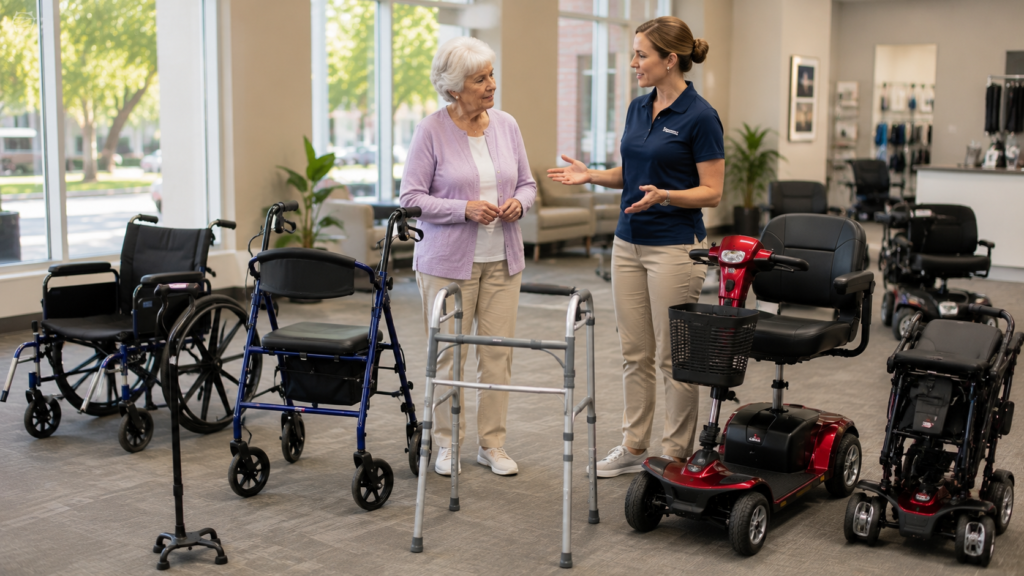
Level of mobility — Will this person require minimal assistance for balancing or more significant mobility assistance?
Type of activity — There is some equipment which is ideal for indoor use and vice versa; for instance, the 3-wheel
scooter and traditional walker are great for indoor use, while 4-wheel scooters and rollators are perfect for outside.
Lifestyle — An active senior citizen will have other mobility requirements compared to a senior who requires help moving indoors.
Medical issues — Arthritis, neuropathy, stroke recovery, and problems with balance each will require different mobility devices.
Recommendations from healthcare providers — These professionals can evaluate the patient’s strength, balance, and coordination and make recommendations accordingly.
It is important to note that the requirements of mobility usually change. The mobility device a person required previously, may not be what he or she needs now. For example, a cane may have been sufficient at one point, while later on, a rollator or scooter will be needed.
How Caregivers Can Support Senior Mobility
Nothing is more critical than learning how to use the mobility aid in a safe manner. This issue should be dealt with by a family caregiver.
Independence encouragement: You can wish to perform all activities alone because you are part of the family, but encouraging a senior to use the mobility device is a good method for maintaining independence and strength.

Safe mobility: Caregivers may help in the process of making paths clear and checking if there is enough light and uneven surfaces are indicated.
Home assistance: Small modifications in the house will help a lot in increasing the level of comfort of using a mobility device.
Safety of the equipment: It is necessary to check regularly the condition of the tires, brakes, and frames of walkers, rollators, and scooters to avoid potential problems.
Mental support: Getting used to the new aid takes time as elderly people usually have problems with the adaptation process and are resistant to it.
Maintenance of Mobility Equipment
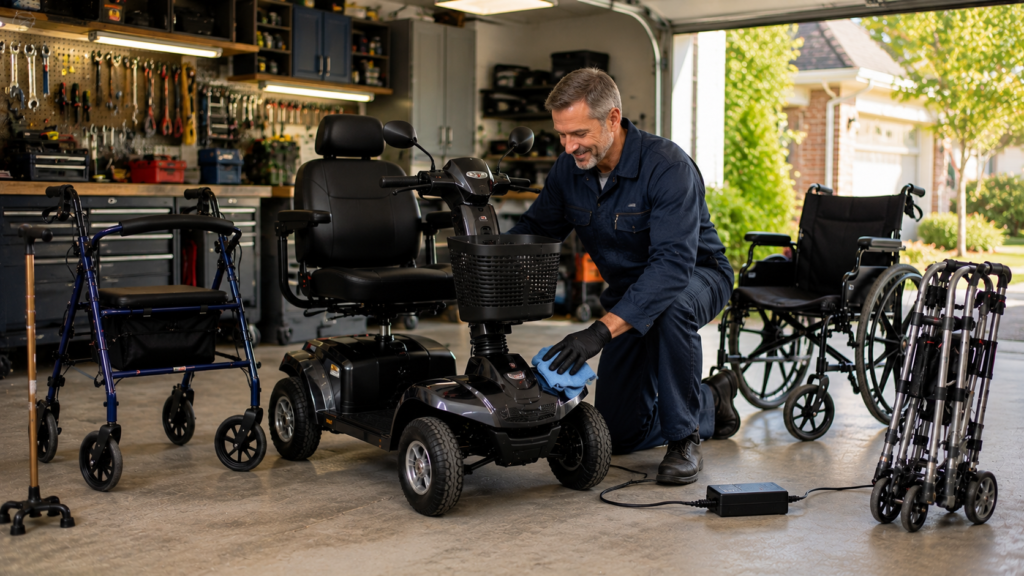
The right maintenance of mobility equipment will assist you to use your equipment safely.
Wheelchair: Check the air pressure, clean your wheels from any dirt, and prevent rusting.
Mobility scooter: Charge your battery as per the instructions from the manufacturer, check the brakes regularly, and keep your scooter in a dry place.
Walker: Ensure your rubber tips or wheels are in good condition; otherwise, fasten your loose parts.
Rollator: Inspect the hand brake, keep your wheels clean, and maintain the folding system of your seat.
Walking stick: Change the rubber tips on time since damaged tips will reduce your grip capability and make you prone to falls.
Lift chair: Keep your motors clean from any dust and maintain the lifting mechanism from time to time.
Just a couple of minutes of maintenance will save you from facing unexpected situations with your equipment.
Frequently Asked Questions
Which mobility device would suit elderly patients?
The answer is very complicated since everything depends on the condition of the patient and his/her way of life. The cane would be suitable for elderly patients with slight balance problems but not for those with severe balance problems since rollators and scooters would be necessary for them.
When should one use mobility devices?
In case when a person has questions about his/her walking abilities and problems with walking, one should consult experts.
Are there any mobility aids that are Medicare covered?
Yes, some of the mobility aids are Medicare covered under particular circumstances. In such case, one should contact Medicare staff members.
How can I make my older relative more independent?
It is possible to make elderly patients more independent through the use of mobility aids and the creation of a safe environment for them at home.
What kinds of mobility aids are meant for outdoor usage?
There are some mobility aids which are meant for outdoor use: 4-wheel mobility scooter and rollator but not for indoor use.
How can I figure out what kind of mobility device would be suitable for me?
An initial discussion with a doctor or physical therapist who can assess your strength, balance, and other factors is essential for choosing the right mobility device.
Can mobility devices lower the risk of falling down?
Yes, if mobility devices are properly fitted and used appropriately, there will be no problem with falling down.
Are mobility needs of seniors constant or do they change with time?
Very often, mobility needs of seniors change with time, that is why it is very useful to consult a healthcare professional regularly.
Conclusion
The mobility aids available to senior citizens in the United States vary widely, from simple walking canes to electric scooters and lift chairs, depending on the degree of assistance needed. The important thing is not which aid the individual chooses, but whether it is appropriate for his body type and lifestyle and fits into all the environments he moves around in, whether that be at home, a shopping mall, or the park.