

Table of Contents
- What Is a Lift Chair?
- Benefits of Choosing the Right Lift Chair
- Step 1: Understand the Different Types of Lift Chairs
- Step 2: Choose the Correct Lift Chair Size
- Step 3: Check Weight Capacity
- Step 4: Select the Best Reclining Position
- Step 5: Evaluate Comfort Features
- Step 6: Consider Helpful Features
- Step 7: Match the Chair to Medical Needs
- Step 8: Measure Your Room
- Step 9: Compare Upholstery Materials
- Step 10: Compare Warranty & Customer Support
- Common Mistakes to Avoid
- Lift Chair Buying Checklist
- Frequently Asked Questions
- Conclusion
Introduction
If you’ve started shopping for a recliner that does more than simply recline, you’re probably wondering how to choose a lift chair that provides the right combination of comfort, safety, and independence. This Lift Chair Buying Guide is designed to help seniors, caregivers, and family members make an informed decision when selecting the best option for long-term daily use.
A lift chair may look like an ordinary recliner, but it features a motorized lifting mechanism that gently tilts the seat forward to help users stand up safely and sit down with less effort. Power Lift Chairs are especially beneficial for people with arthritis, limited mobility, balance problems, or those recovering from surgery. Choosing the right model can reduce strain, improve confidence, and make everyday living more comfortable.
This comprehensive Lift Chair Guide explains how to choose a lift chair by comparing lift chair types, sizes, weight capacities, reclining positions, comfort features, medical considerations, and warranty coverage. Whether you’re searching for the Best Lift Chair for Seniors or exploring different Lift Chairs for Seniors, this guide covers everything you need to know. By the end, you’ll feel confident about choosing a lift chair that fits your mobility needs, home environment, and lifestyle.
What Is a Lift Chair?
A lift chair, also known as a power lift chair or electric lift chair, is an electrically operated reclining chair with a built-in lifting system. With one touch of a button, the lifting function raises the base of the chair and tilts it forward such that the person in it is partially lifted to a standing position. The person then needs to move just a little forward to be able to stand fully up as opposed to having to push themselves up from the sitting position in the chair.
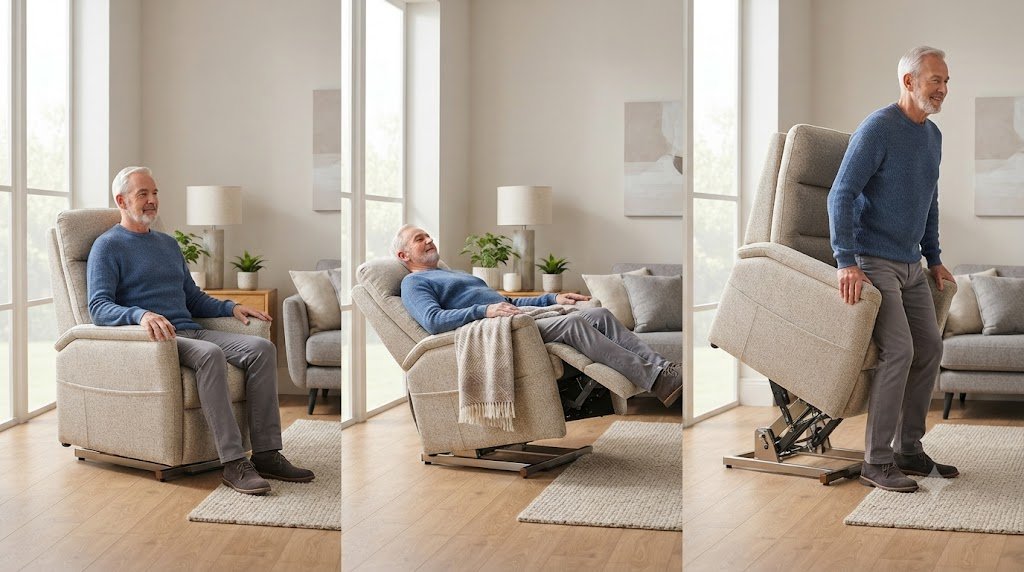
How does it work? There is an electric motor inside the frame of the chair which powers a lifting arm underneath the chair. When turned on, the whole chair lifts and pivots so that the center of gravity of the person is shifted towards the feet.
Lift chair versus recliner: In a traditional recliner, there is merely an adjustment in the position of both the backrest and footrest, but the seat of the recliner does not move from the horizontal position. However, the lift chair comes equipped with an additional standing assist feature. Hence, it can be termed as a mobility recliner.
Whom does it suit?: The use of lift chairs is usually advised for seniors who have arthritis, suffer from chronic back and hip problems, weak legs, or people who have undergone joint replacement surgery. People who need help in rising from a sitting position are among the users of lift chairs.
Benefits of Choosing the Right Lift Chair
Selecting a proper chair and not just any lift chair brings multiple advantages:
- Greater independence. Being able to stand up on their own allows users to become independent in performing the most basic activity.
- Easy standing up and sitting down. The lifting mechanism takes out the need for any exertion in both actions.
- Lower dependence on caregivers. There will be fewer physical transfers and therefore less physical work done by those who help.
- Proper posture. With a proper chair, the spine is kept straight, which is not always the case with regular chairs.
- Pressure point relief. The chair provides good cushioning and positions that help distribute the user’s weight.
- Improved circulation. Elevated legs allow blood to flow better and can even reduce swelling.
- Better sleeping and relaxing. The chairs come with positions for taking a nap or resting.
- Aging in place. A properly selected lift chair allows one to age in place longer.
- Falls prevention. Controlled and powered rise eliminates the possibility of falling when transferring.
Step 1: Understand the Different Types of Lift Chairs
Every lift chair buying guide should start here, because the type of chair determines almost everything else — comfort, price, and suitability for specific needs.
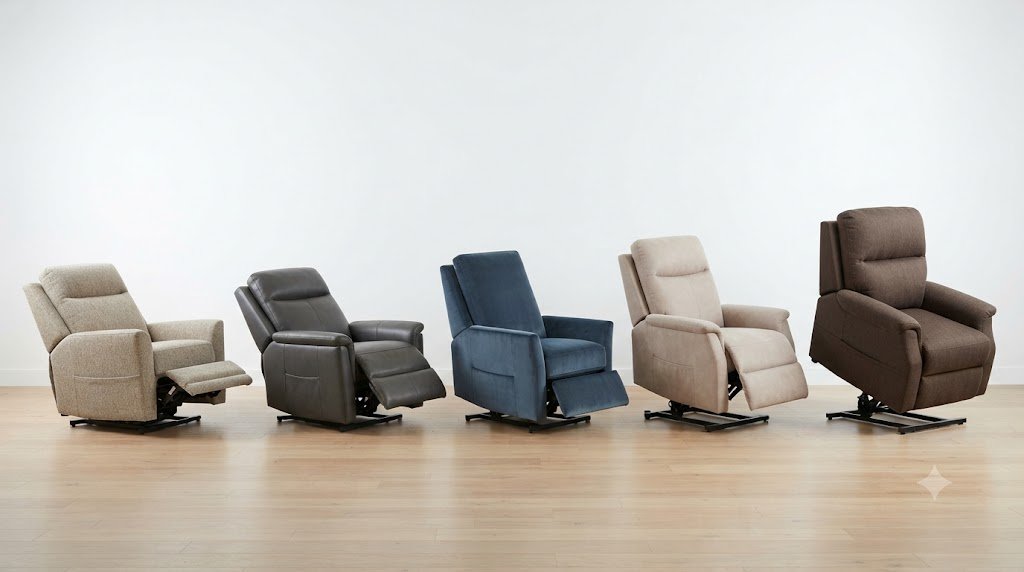
Two-Position Lift Chairs
These recline to roughly a 45-degree angle with the footrest raised. They’re the simplest and most affordable lift recliner chair option, ideal for seniors who mainly need help standing and want light reclining for TV-watching or reading.
Three-Position Lift Chairs
These add a deeper recline — closer to flat — for more pressure relief on the back and hips. They suit users who want to nap or relax for longer stretches without needing a fully horizontal chair.
Infinite Position Lift Chairs
An infinite position lift chair uses independent motors for the backrest and footrest, letting the user stop at any angle rather than fixed positions. This is one of the most popular choices for seniors with circulation issues, back pain, or those who want to sleep in the chair occasionally.
Zero Gravity Lift Chairs
A zero gravity lift chair reclines so the legs are elevated slightly above heart level, distributing body weight evenly and taking pressure off the spine — a position inspired by the posture astronauts use during launch. It’s especially popular for arthritis and lower-back pain relief.
Heavy-Duty Lift Chairs
Also called bariatric lift chairs, heavy-duty lift chairs are built with reinforced frames, wider seats, and stronger motors to support higher weight capacities, often 350 to 500+ pounds.
Step 2: Choose the Correct Lift Chair Size
Getting lift chair sizes right matters as much as picking the type. A chair that’s too small forces awkward posture; one that’s too large won’t support the body properly.
Measure and match:
- Seat width — should allow about an inch of clearance on each side of the hips.
- Seat depth — the back of the knees should sit close to the front edge of the seat without dangling past it.
- Seat height — feet should rest flat on the floor with knees at roughly a 90-degree angle when seated.
- Back height — should support the head and shoulders, especially for taller users.
- User height and weight — most manufacturers list recommended height/weight ranges per model.
- Leg positioning — the footrest should support the calves without pressing behind the knees.
- Armrest height — elbows should rest comfortably without shrugging the shoulders.
- Proper body alignment — the goal is a neutral spine position, not a slouched or overly upright posture.
Step 3: Check Weight Capacity
Lift chair weight capacity isn’t just a number on a spec sheet — it affects safety and long-term durability.
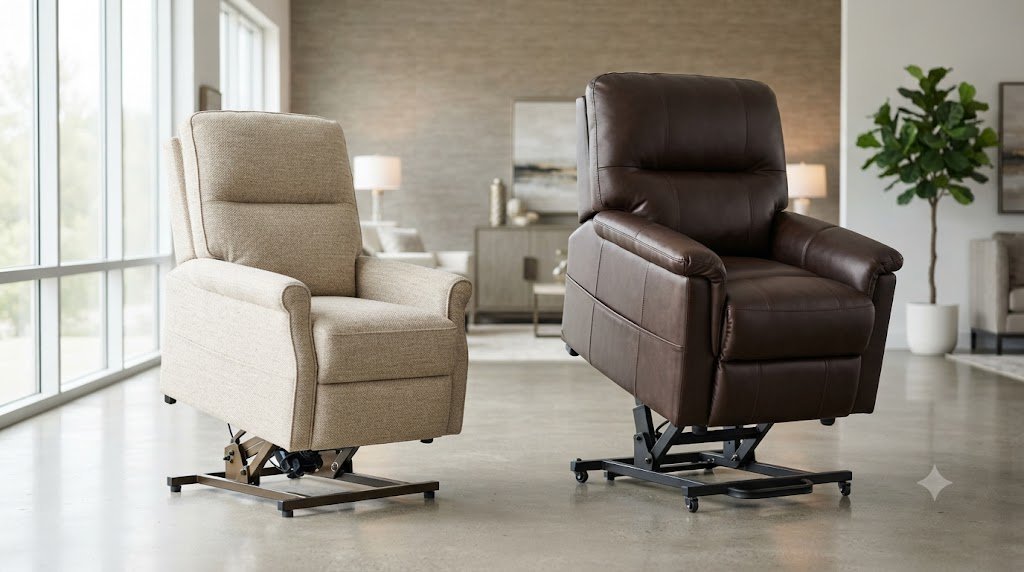
- Standard models typically support 300–375 lbs.
- Bariatric lift chairs are engineered for 400–700 lbs, with wider seats and reinforced steel frames.
- Safety margins matter: choose a chair rated comfortably above the user’s actual weight, not right at the limit.
- Durability considerations: heavier-duty motors and frames also tend to hold up better over years of daily use, even for users within a standard weight range.
Step 4: Select the Best Reclining Position
Different recline angles serve different purposes throughout the day.
| Position | Typical Use |
| Sitting (upright) | Eating, conversation, using a tablet or phone |
| TV Position | Slight recline with feet elevated for casual viewing |
| Reading Position | Deep relaxation, extended rest |
| Infinite Position | Any custom angle for individualized comfort |
| Sleeping Position | Near-flat or zero-gravity angle for occasional napping |
Seniors who spend a lot of time in their chair — for reading, resting, or recovering from surgery — generally benefit most from an infinite position lift chair or zero gravity lift chair, since they aren’t locked into just two or three fixed angles.
Step 5: Evaluate Comfort Features
Comfort features turn a medical lift chair into a chair someone actually wants to sit in every day.
- High-density foam holds its shape longer and resists sagging.
- Lumbar support helps maintain the natural curve of the lower spine.
- Headrest support matters most for taller users or those who recline frequently.
- Footrest design should extend fully and support the calves evenly.
- Cushion firmness is a personal preference — firmer cushions assist standing, softer ones favor comfort.
- Breathable fabric helps regulate temperature during long sitting sessions.
- Leather vs. fabric — leather wipes clean easily; fabric tends to feel warmer and softer.
- Heat and massage functions can ease muscle tension, especially for arthritis or back pain.
- Ergonomic design overall should support natural posture in every recline position.
Step 6: Consider Helpful Features
Beyond core comfort, several extras can make daily use noticeably easier:
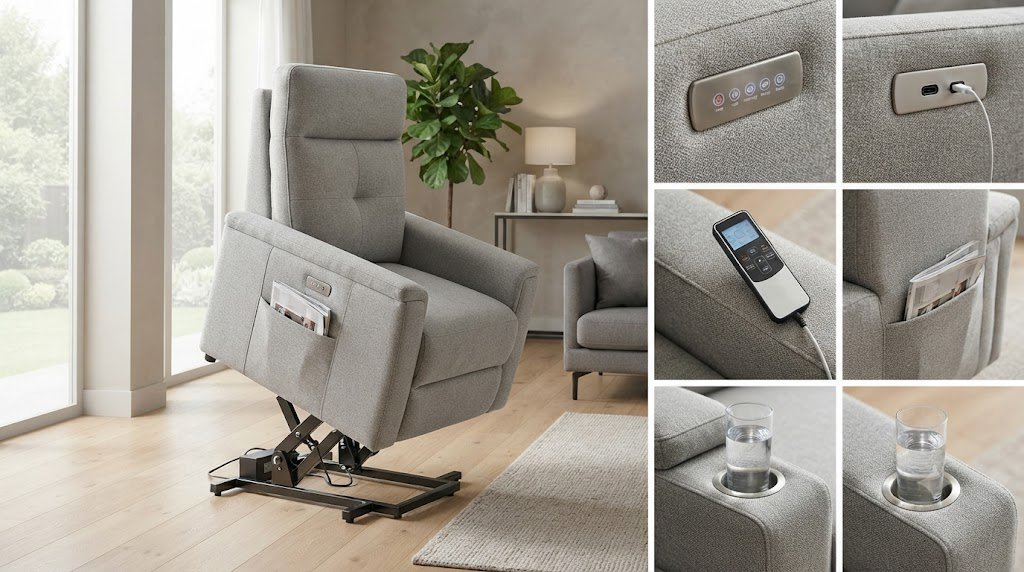
- Heat & massage settings for muscle relief
- USB charging ports built into the armrest
- Battery backup to allow the lift function to work during a power outage
- Side pockets for remotes, glasses, or a phone
- Cup holders for convenience
- Wireless remote control with large, easy-to-read buttons
- Memory positions to save favorite recline angles
- Adjustable headrest for personalized support
- Adjustable lumbar support for targeted lower-back relief
Step 7: Match the Chair to Medical Needs
The right lift chair for elderly users often depends heavily on their specific health condition:
- Arthritis — look for a lift chair for arthritis with zero-gravity or infinite-position recline and soft, pressure-relieving cushioning.
- Back pain — a lift chair for back pain should offer strong lumbar support and a near-flat recline option.
- Hip or knee replacement recovery — prioritize higher seat height and a firmer cushion that assists standing.
- Parkinson’s disease — smooth, predictable lift speed and a stable frame are important.
- Multiple sclerosis — adjustable positions help manage fatigue and muscle stiffness throughout the day.
- Stroke recovery — consider chairs with wider armrests and extra lateral support.
- Limited mobility or balance issues — a slower, controlled lift speed and non-slip footrest surface add safety.
Because medical needs vary so much, it’s worth discussing chair features with a doctor or physical therapist — especially for a lift chair for elderly parents or a lift chair for disabled adults where the buyer isn’t the end user.
Step 8: Measure Your Room
Even the best chair won’t work well in the wrong space. Before buying, check:
- Wall clearance — many lift chairs need 4–8 inches of space behind them to fully recline.
- Chair dimensions — measure width, depth, and height against your available floor space.
- Doorway access — confirm the chair (or its boxed dimensions) will fit through hallways and doorways.
- Electrical outlet location — the chair needs to be near a standard outlet.
- Safe walking space — leave enough clearance around the chair for a safe, unobstructed standing path.
Step 9: Compare Upholstery Materials
| Material | Durability | Breathability | Cleaning | Comfort |
| Fabric | Moderate | High | Needs fabric cleaner, can stain | Soft, warm |
| Microfiber | Good | Moderate | Easy to wipe, stain-resistant | Soft, cozy |
| Faux Leather | Good | Lower | Very easy to wipe clean | Firm, cool to the touch |
| Genuine Leather | Excellent | Moderate | Wipeable, needs conditioning | Premium feel, ages well |
Households with pets, spills, or incontinence concerns often lean toward faux leather or microfiber for easier cleaning, while fabric tends to feel more comfortable for extended sitting.
Step 10: Compare Warranty & Customer Support
A lift chair warranty protects a significant investment, so compare:

- Frame warranty — often the longest-covered component, sometimes lifetime or 10+ years.
- Motor warranty — typically 2–5 years, since the motor is the most mechanically active part.
- Electronics warranty — covers the remote and control unit, usually 1–3 years.
- Labor coverage — check whether in-home repair labor is included or billed separately.
- Replacement parts — confirm parts are readily available, not discontinued after a year or two.
- Customer support — look for companies with responsive phone support and clear return policies.
Common Mistakes to Avoid
- Buying the wrong size based on guesswork instead of actual measurements.
- Ignoring weight limits, which shortens motor lifespan and creates safety risk.
- Choosing based only on price, missing out on better long-term comfort or durability.
- Forgetting room measurements, leading to a chair that doesn’t fit the space.
- Ignoring medical needs, buying a general chair when a specific condition calls for particular features.
- Not checking the warranty, only to face expensive repairs later.
- Buying unnecessary features that inflate the price without adding real value for the user.
Lift Chair Buying Checklist

- Correct seat width, depth, and height measured
- Weight capacity exceeds user’s weight with a safety margin
- Preferred recline positions identified (two-position, infinite, zero gravity, etc.)
- Comfort features tested or reviewed (foam density, lumbar support, headrest)
- Upholstery material matches lifestyle needs
- Helpful features selected (heat/massage, USB port, battery backup)
- Warranty terms compared across frame, motor, and electronics
- Budget set, including delivery and any assembly costs
- Room measured for chair size, wall clearance, and outlet access
- Medical requirements discussed with a healthcare provider if needed
Frequently Asked Questions
How do I choose the right lift chair? Start with accurate body measurements, then match them to a chair’s seat width, depth, and height. From there, factor in weight capacity, preferred recline positions, and any medical needs before comparing comfort features and warranty.
What size lift chair do I need? Seat width should allow roughly an inch of clearance on each side, seat depth should support the thighs without pressing behind the knees, and seat height should let the feet rest flat on the floor.
Are lift chairs covered by Medicare? Medicare Part B may cover the seat-lift mechanism as durable medical equipment when a doctor certifies it’s medically necessary, but it does not cover the chair or seating portion itself. Coverage requires a Medicare-enrolled supplier and, in 2026, is subject to the annual Part B deductible plus 20% coinsurance on the mechanism cost. It’s best to confirm current requirements directly with Medicare or a licensed supplier.
Which lift chair is best for seniors? There’s no single “best” model — it depends on the person’s size, medical needs, and how they plan to use the chair. Someone who mainly needs standing assistance may do fine with a two-position chair, while someone managing arthritis or chronic back pain may benefit more from an infinite-position or zero-gravity model.
Can you sleep in a lift chair? Occasional short naps are common in infinite-position or zero-gravity chairs reclined to a near-flat angle. They aren’t typically designed to replace a bed for full nightly sleep, though some users with certain medical conditions do use them regularly under a doctor’s guidance.
What is the difference between a recliner and a lift chair? A standard recliner adjusts the backrest and footrest but keeps the seat close to the floor. A lift chair adds a motorized mechanism that tilts and raises the entire seat to assist the user into a standing position.
How long does a lift chair last? With regular use and proper care, a good-quality lift chair often lasts 7–10 years or more, though motor lifespan can vary based on usage frequency and weight load.
Are lift chairs safe? Reputable lift chairs go through safety testing and include features like slow, controlled lift speeds and stable frames. Choosing the correct size and weight capacity for the user is one of the biggest factors in safe, long-term use.
What weight can a lift chair support? Standard lift chairs typically support 300–375 lbs, while heavy-duty or bariatric models are built to support 400–700 lbs depending on the manufacturer.
Which lift chair position is best for sleeping? An infinite-position or zero-gravity recline, which brings the chair close to flat while keeping the legs elevated, tends to be most comfortable for occasional in-chair rest.
Conclusion
In summary, the process of selecting a lift chair requires that you match the chair to yourself, not vice versa. Begin with taking precise measurements, determine the weight capacity and health requirements of the chair and select recline positions and features that complement your activities. Then, compare the upholsteries, warranty options, and any other useful feature to find a suitable chair.
Spending time on careful measurement, taking into account your health needs, comparing features, and seeking advice from your healthcare provider will all be worth it in the long run.