
If you or someone you love has started to feel a little less steady on their feet, you’re not alone. Millions of older adults across the country face the same quiet worry every day: will I trip on the sidewalk, lose my balance in the kitchen, or fall getting up from a chair? For many seniors, a standard walker turns out to be the simplest, most reassuring answer to that worry.
This guide walks you through everything you need to know about standard walkers — what they are, how they work, who benefits most from them, and how to pick the right one. Whether you’re shopping for yourself or helping an aging parent, you’ll walk away with practical, no-nonsense information you can actually use.

What Is a Standard Walker?
A standard walker is a lightweight metal frame, usually made of aluminum, with four rubber-tipped legs and no wheels. You lift it slightly with each step, move it forward, and then step into it. It’s often called a “pick-up walker” for exactly that reason.
Unlike rollators or wheeled walkers, standard walkers don’t roll on their own, which means they offer the most stability of any walking aid on the market. That extra stability is exactly why so many physical therapists recommend them for people who need serious support while walking.
Most models fold flat for storage or car trips, and nearly all allow you to adjust the height to match the user’s build. Hand grips are typically cushioned foam or rubber, and the legs end in non-slip rubber tips that grip tile, hardwood, and pavement alike.
How Does a Standard Walker Work?
Using a standard walker is simple once you get the rhythm down. You hold the grips, lift the frame a few inches off the ground, place it a step’s length ahead of you, and then step forward into the space it creates. Because all four legs touch the ground at once when you plant it, it creates a wide, stable base that resists tipping.
This lift-and-step motion is slower than walking with a rollator, but that’s part of the appeal. It forces a deliberate pace, which is often exactly what someone recovering from hip surgery or managing severe balance issues needs.
Some newer standard walkers include front glide skis or two front wheels — sometimes called two-wheeled walkers — which reduce the lifting motion while keeping most of the stability. These hybrid models are worth mentioning to a physical therapist if full lifting feels too tiring.
Who Can Benefit from a Standard Walker?

Standard walkers tend to work best for people who need maximum support and don’t mind a slower, more deliberate pace. That includes:
- Seniors recovering from hip or knee replacement surgery
- People managing Parkinson’s disease, stroke recovery, or significant balance disorders
- Individuals with lower body weakness or recent falls
- Anyone told by a doctor or physical therapist that they need “non-weight-bearing” or “limited weight-bearing” support
- Caregivers looking for the safest possible walking aid for a parent or spouse
If someone is fairly steady but just wants a bit of extra confidence, a rollator or cane might actually suit them better — we’ll get into that comparison shortly.
Benefits of Standard Walkers

There’s a reason standard walkers remain a go-to recommendation in hospitals and rehab centers nationwide. Here’s what makes them stand out:
| Benefit | Why It Matters |
|---|---|
| Maximum stability | Four planted legs create the widest, steadiest base of any walking aid |
| Lightweight design | Aluminum frames are easy to lift and maneuver, even for frail users |
| Affordable | Typically one of the least expensive mobility aids available |
| Adjustable height | Fits users of nearly any height for proper posture |
| Foldable | Easy to store in a closet or car trunk |
| No batteries or motors | Simple, reliable, and low-maintenance |
For a senior recovering from surgery, that stability can mean the difference between confidently crossing the living room and hesitating at the doorway. For a caregiver, it can mean fewer sleepless nights worrying about a fall.
Potential Limitations
No mobility aid is perfect for every situation, and it’s worth being honest about the trade-offs. Standard walkers require enough arm and shoulder strength to lift the frame repeatedly, which can be tiring over long distances. They’re also slower than wheeled options, and they don’t work well on uneven outdoor terrain like gravel paths or grass.
Some users also find the constant lifting motion awkward at first, especially if they have arthritis in their hands or wrists. It usually takes a few days of practice to build a comfortable rhythm.
Key Features to Consider
[Image placeholder: Detailed view of a folding standard walker showing adjustable height, ergonomic hand grips, and non-slip rubber tips.]
When comparing models, a few features make a real difference in day-to-day comfort:
- Weight capacity: Check this against the user’s weight, with some room to spare.
- Height adjustability: Grips should sit at wrist height when arms hang naturally at the sides.
- Grip comfort: Foam or contoured rubber grips reduce hand fatigue, especially for arthritis sufferers.
- Folding mechanism: A simple one-hand fold is much easier for caregivers managing car trunks.
- Rubber tip quality: Thicker, textured tips grip better on wet or tiled floors.
- Optional accessories: Trays, baskets, or bag attachments can help with carrying small items.
Standard Walker vs. Rollator
| Feature | Standard Walker | Rollator |
|---|---|---|
| Wheels | None (fully lifted) | Three or four wheels |
| Stability | Highest | Moderate to high |
| Speed | Slower | Faster, more natural gait |
| Best for | Serious balance or weight-bearing limits | Users who are steadier but tire easily |
| Terrain | Best on flat, indoor surfaces | Handles outdoor terrain better |
| Seat included | No | Often yes |
If you’re still deciding between the two, our Rollators guide breaks down rollator options in more detail.
Standard Walker vs. Walking Cane
| Feature | Standard Walker | Walking Cane |
|---|---|---|
| Support level | Full, four-point support | Light, single-point support |
| Best for | Significant balance or strength issues | Mild instability or minor support needs |
| Portability | Folds, but bulkier | Extremely portable |
| Learning curve | Moderate | Minimal |
For seniors who only need a light touch of support, our Walking Canes guide covers styles and sizing in depth.
How to Choose the Right Standard Walker
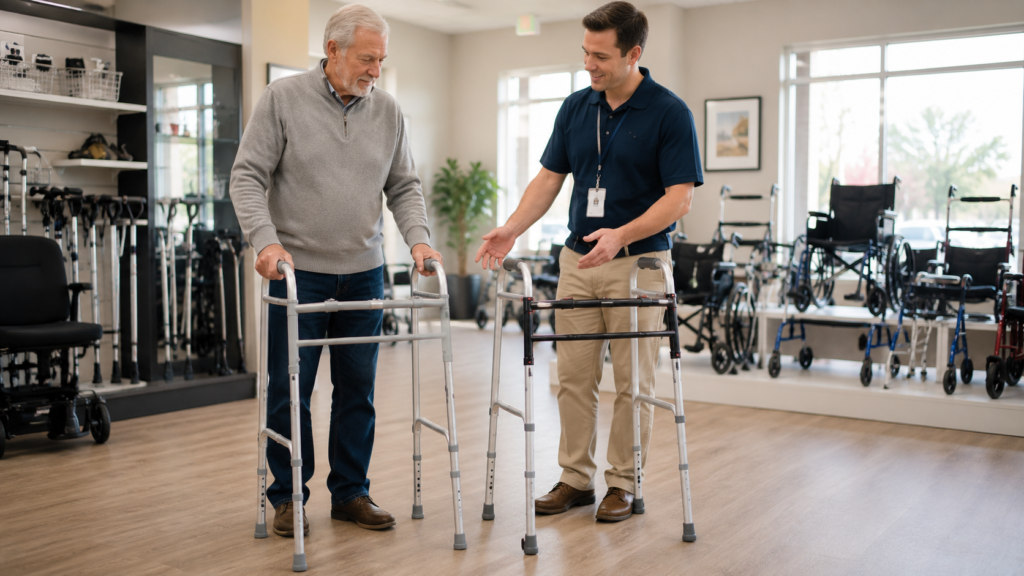
Start with a conversation with a doctor or physical therapist, since they can confirm how much support is truly needed. From there, think through:
- Living space: Narrow hallways may need a smaller frame width.
- Strength and stamina: If lifting feels difficult, ask about two-wheeled versions.
- Height range: Confirm the adjustable range fits comfortably.
- Transport needs: A folding frame matters if the walker will travel in a car often.
- Budget: Compare models, but never sacrifice stability for a lower price.
Our full Walker Buying Guide offers a deeper checklist if you want to compare specs side by side.
Safety Tips for Everyday Use
- Always check that all four rubber tips are worn evenly and replace them if cracked or smooth.
- Wear supportive, non-slip shoes rather than socks or slippers.
- Keep the walker at wrist height so posture stays upright, not hunched.
- Clear walkways of rugs, cords, and clutter that could catch a walker leg.
- Take it slow on thresholds, ramps, and any uneven flooring transitions.
- Ask a caregiver or therapist to double-check your fit and technique periodically.
Maintenance and Care
Standard walkers need very little upkeep, but a few habits keep them safe and functional for years. Wipe down the frame regularly, especially the grips, to keep it hygienic. Check the tightness of height-adjustment clips or locking pins every few weeks, since regular use can loosen them over time.
Replace rubber tips as soon as they look worn smooth, since a worn tip loses much of its grip. If the walker folds, make sure the folding hinge locks securely before every use — a loose hinge is one of the most common causes of walker-related falls.
Frequently Asked Questions
Is a standard walker covered by Medicare? Standard walkers are often covered under Medicare Part B as durable medical equipment when prescribed by a doctor, though coverage details and out-of-pocket costs can vary.
What’s the average cost of a standard walker? Basic aluminum models are generally one of the more affordable mobility aids available, though prices vary by brand, features, and accessories.
Can a standard walker be used outdoors? Yes, but it performs best on flat, paved surfaces. Grass, gravel, or steep inclines can be more challenging.
How do I know if I need a walker instead of a cane? If a doctor or therapist has flagged significant balance issues, weight-bearing restrictions, or recent falls, a walker typically offers more support than a cane.
Do standard walkers fold for travel? Most models fold flat, making them easy to fit in a car trunk or airplane overhead bin, though it’s worth checking the folded dimensions before buying.
How often should rubber tips be replaced? Check them monthly; replace them as soon as they appear worn, cracked, or smooth, since grip loss increases fall risk.
Are two-wheeled walkers better than standard walkers? Not necessarily better — they trade a bit of stability for less lifting effort, which can suit users with limited upper body strength.
Conclusion
[Image placeholder: A happy senior maintaining independence while using a standard walker on a sunny outdoor walking path.]
Choosing a standard walker isn’t just about picking a mobility aid — it’s about protecting independence, confidence, and safety for the years ahead. With the right fit, proper technique, and a bit of regular maintenance, a standard walker can help seniors move through their homes and neighborhoods with far less worry.
If you’re still weighing your options, take a look at our guides on rollators, walking canes, and wheelchairs to compare every level of mobility support side by side — or explore transport wheelchairs, electric wheelchairs, mobility scooters, and lift chairs for other ways to make daily life easier.
- If you or someone you love has started to feel a little less steady on their feet, you’re not alone. Millions of older adults across the country face the same quiet worry every day: will I trip on the sidewalk, lose my balance in the kitchen, or fall getting up from a chair? For many seniors, a standard walker turns out to be the simplest, most reassuring answer to that worry.
This guide walks you through everything you need to know about standard walkers — what they are, how they work, who benefits most from them, and how to pick the right one. Whether you’re shopping for yourself or helping an aging parent, you’ll walk away with practical, no-nonsense information you can actually use.
What Is a Standard Walker?
A standard walker is a lightweight metal frame, usually made of aluminum, with four rubber-tipped legs and no wheels. You lift it slightly with each step, move it forward, and then step into it. It’s often called a “pick-up walker” for exactly that reason.
Unlike rollators or wheeled walkers, standard walkers don’t roll on their own, which means they offer the most stability of any walking aid on the market. That extra stability is exactly why so many physical therapists recommend them for people who need serious support while walking.
Most models fold flat for storage or car trips, and nearly all allow you to adjust the height to match the user’s build. Hand grips are typically cushioned foam or rubber, and the legs end in non-slip rubber tips that grip tile, hardwood, and pavement alike.
How Does a Standard Walker Work?
Using a standard walker is simple once you get the rhythm down. You hold the grips, lift the frame a few inches off the ground, place it a step’s length ahead of you, and then step forward into the space it creates. Because all four legs touch the ground at once when you plant it, it creates a wide, stable base that resists tipping.
This lift-and-step motion is slower than walking with a rollator, but that’s part of the appeal. It forces a deliberate pace, which is often exactly what someone recovering from hip surgery or managing severe balance issues needs.
Some newer standard walkers include front glide skis or two front wheels — sometimes called two-wheeled walkers — which reduce the lifting motion while keeping most of the stability. These hybrid models are worth mentioning to a physical therapist if full lifting feels too tiring.
Who Can Benefit from a Standard Walker?
[Image placeholder: An older adult using a standard walker with the support of a caregiver during a walk in a park.]
Standard walkers tend to work best for people who need maximum support and don’t mind a slower, more deliberate pace. That includes:
Seniors recovering from hip or knee replacement surgery
People managing Parkinson’s disease, stroke recovery, or significant balance disorders
Individuals with lower body weakness or recent falls
Anyone told by a doctor or physical therapist that they need “non-weight-bearing” or “limited weight-bearing” support
Caregivers looking for the safest possible walking aid for a parent or spouse
If someone is fairly steady but just wants a bit of extra confidence, a rollator or cane might actually suit them better — we’ll get into that comparison shortly.
Benefits of Standard Walkers
[Image placeholder: A senior confidently using a standard walker while walking through a community center or rehabilitation clinic.]
There’s a reason standard walkers remain a go-to recommendation in hospitals and rehab centers nationwide. Here’s what makes them stand out:
Benefit
Why It Matters
Maximum stability
Four planted legs create the widest, steadiest base of any walking aid
Lightweight design
Aluminum frames are easy to lift and maneuver, even for frail users
Affordable
Typically one of the least expensive mobility aids available
Adjustable height
Fits users of nearly any height for proper posture
Foldable
Easy to store in a closet or car trunk
No batteries or motors
Simple, reliable, and low-maintenance
For a senior recovering from surgery, that stability can mean the difference between confidently crossing the living room and hesitating at the doorway. For a caregiver, it can mean fewer sleepless nights worrying about a fall.
Potential Limitations
No mobility aid is perfect for every situation, and it’s worth being honest about the trade-offs. Standard walkers require enough arm and shoulder strength to lift the frame repeatedly, which can be tiring over long distances. They’re also slower than wheeled options, and they don’t work well on uneven outdoor terrain like gravel paths or grass.
Some users also find the constant lifting motion awkward at first, especially if they have arthritis in their hands or wrists. It usually takes a few days of practice to build a comfortable rhythm.
Key Features to Consider
[Image placeholder: Detailed view of a folding standard walker showing adjustable height, ergonomic hand grips, and non-slip rubber tips.]
When comparing models, a few features make a real difference in day-to-day comfort:
Weight capacity: Check this against the user’s weight, with some room to spare.
Height adjustability: Grips should sit at wrist height when arms hang naturally at the sides.
Grip comfort: Foam or contoured rubber grips reduce hand fatigue, especially for arthritis sufferers.
Folding mechanism: A simple one-hand fold is much easier for caregivers managing car trunks.
Rubber tip quality: Thicker, textured tips grip better on wet or tiled floors.
Optional accessories: Trays, baskets, or bag attachments can help with carrying small items.
Standard Walker vs. Rollator
Feature
Standard Walker
Rollator
Wheels
None (fully lifted)
Three or four wheels
Stability
Highest
Moderate to high
Speed
Slower
Faster, more natural gait
Best for
Serious balance or weight-bearing limits
Users who are steadier but tire easily
Terrain
Best on flat, indoor surfaces
Handles outdoor terrain better
Seat included
No
Often yes
If you’re still deciding between the two, our Rollators guide breaks down rollator options in more detail.
Standard Walker vs. Walking Cane
Feature
Standard Walker
Walking Cane
Support level
Full, four-point support
Light, single-point support
Best for
Significant balance or strength issues
Mild instability or minor support needs
Portability
Folds, but bulkier
Extremely portable
Learning curve
Moderate
Minimal
For seniors who only need a light touch of support, our Walking Canes guide covers styles and sizing in depth.
How to Choose the Right Standard Walker
[Image placeholder: A senior comparing two standard walker models with a mobility specialist inside a mobility equipment showroom.]
Start with a conversation with a doctor or physical therapist, since they can confirm how much support is truly needed. From there, think through:
Living space: Narrow hallways may need a smaller frame width.
Strength and stamina: If lifting feels difficult, ask about two-wheeled versions.
Height range: Confirm the adjustable range fits comfortably.
Transport needs: A folding frame matters if the walker will travel in a car often.
Budget: Compare models, but never sacrifice stability for a lower price.
Our full Walker Buying Guide offers a deeper checklist if you want to compare specs side by side.
Safety Tips for Everyday Use
Always check that all four rubber tips are worn evenly and replace them if cracked or smooth.
Wear supportive, non-slip shoes rather than socks or slippers.
Keep the walker at wrist height so posture stays upright, not hunched.
Clear walkways of rugs, cords, and clutter that could catch a walker leg.
Take it slow on thresholds, ramps, and any uneven flooring transitions.
Ask a caregiver or therapist to double-check your fit and technique periodically.
Maintenance and Care
Standard walkers need very little upkeep, but a few habits keep them safe and functional for years. Wipe down the frame regularly, especially the grips, to keep it hygienic. Check the tightness of height-adjustment clips or locking pins every few weeks, since regular use can loosen them over time.
Replace rubber tips as soon as they look worn smooth, since a worn tip loses much of its grip. If the walker folds, make sure the folding hinge locks securely before every use — a loose hinge is one of the most common causes of walker-related falls.
Frequently Asked Questions
Is a standard walker covered by Medicare? Standard walkers are often covered under Medicare Part B as durable medical equipment when prescribed by a doctor, though coverage details and out-of-pocket costs can vary.
What’s the average cost of a standard walker? Basic aluminum models are generally one of the more affordable mobility aids available, though prices vary by brand, features, and accessories.
Can a standard walker be used outdoors? Yes, but it performs best on flat, paved surfaces. Grass, gravel, or steep inclines can be more challenging.
How do I know if I need a walker instead of a cane? If a doctor or therapist has flagged significant balance issues, weight-bearing restrictions, or recent falls, a walker typically offers more support than a cane.
Do standard walkers fold for travel? Most models fold flat, making them easy to fit in a car trunk or airplane overhead bin, though it’s worth checking the folded dimensions before buying.
How often should rubber tips be replaced? Check them monthly; replace them as soon as they appear worn, cracked, or smooth, since grip loss increases fall risk.
Are two-wheeled walkers better than standard walkers? Not necessarily better — they trade a bit of stability for less lifting effort, which can suit users with limited upper body strength.
Conclusion
[Image placeholder: A happy senior maintaining independence while using a standard walker on a sunny outdoor walking path.]
Choosing a standard walker isn’t just about picking a mobility aid — it’s about protecting independence, confidence, and safety for the years ahead. With the right fit, proper technique, and a bit of regular maintenance, a standard walker can help seniors move through their homes and neighborhoods with far less worry.
If you’re still weighing your options, take a look at our guides on rollators, walking canes, and wheelchairs to compare every level of mobility support side by side — or explore transport wheelchairs, electric wheelchairs, mobility scooters, and lift chairs for other ways to make daily life easier.