

Choosing the right wheelchair is one of the most important mobility decisions a senior or caregiver will ever make. When comparing Manual Wheelchairs vs Power Wheelchairs, the right choice can provide greater independence, improved comfort, and a safer daily routine. Choosing the wrong wheelchair, however, may lead to frustration, unnecessary expenses, or even an increased risk of injury.
Understanding the differences between Manual Wheelchairs vs Power Wheelchairs is essential because each option is designed for different mobility needs, lifestyles, and levels of physical ability. This guide explains how each type works, compares their costs, comfort, portability, maintenance, and performance, and helps you determine which wheelchair best suits your daily life. Whether you’re a senior exploring mobility solutions or a caregiver helping a loved one, this comparison will help you make a confident and informed decision.
By the end of this guide, you’ll have a clear understanding of Manual Wheelchairs vs Power Wheelchairs, including their advantages, limitations, and the key factors to consider before choosing the right mobility aid for long-term independence and comfort.
Table of Contents
- What Is a Manual Wheelchair?
- What Is a Power Wheelchair?
- Manual Wheelchairs vs Power Wheelchairs: Comparison Table
- Advantages of Manual Wheelchairs
- Advantages of Power Wheelchairs
- Disadvantages of Manual Wheelchairs
- Disadvantages of Power Wheelchairs
- Cost Comparison
- Comfort Comparison
- Indoor vs Outdoor Performance
- Portability & Travel
- Maintenance Requirements
- Safety Considerations
- Buying Guide
- Frequently Asked Questions
- Conclusion
What Is a Manual Wheelchair? {#what-is-a-manual-wheelchair}
A manual wheelchair is a mobility aid that is moved by hand, either by the user pushing the wheels or by a caregiver pushing the handles. It has no motor or battery, which keeps it light, simple, and easy to fold up.
How It Works
The user (or a caregiver) applies force to large rear wheels, often fitted with a hand rim, to move forward, backward, or turn. Smaller front casters help with steering.
Common Types
- Standard manual wheelchairs – everyday use at home or in care facilities
- Self-propelled wheelchairs – designed for users with enough upper body strength to push themselves
- Transport wheelchairs – lighter, smaller wheels, meant to be pushed by a caregiver
- Lightweight folding wheelchairs – built from aluminum or carbon fiber for easy transport
- Rigid-frame wheelchairs – sturdier, often used by more active wheelchair users
Advantages
- Lightweight and easy to fold
- Lower upfront cost
- Simple to maintain
- No battery to charge
Disadvantages
- Requires physical effort to move
- Can be tiring over long distances
- Less independence for users with limited arm strength
Best Users
A manual wheelchair works best for people who have good upper body strength, need a wheelchair only occasionally, or have a caregiver who can push them. It’s also a smart backup chair for power wheelchair users who travel.

What Is a Power Wheelchair? {#what-is-a-power-wheelchair}
A power wheelchair, also called an electric wheelchair or electric mobility chair, uses a rechargeable battery and motor to move. The user steers with a joystick or, in some cases, an alternative control like a chin switch or sip-and-puff system.
Electric Motor and Controls
Most power wheelchairs use dual motors, one for each rear wheel, allowing smooth turns and precise control. The joystick lets the user adjust speed and direction without any physical strain.
Battery System
Power wheelchairs run on rechargeable batteries, typically lasting 8 to 20 miles per charge depending on the model, terrain, and user weight.
Comfort Features
Many power wheelchairs include:
- Adjustable, cushioned seating
- Power recline or tilt functions
- Adjustable footrests and armrests
- Headrests for extra support
Best Users
A power wheelchair is ideal for people with limited arm strength, chronic fatigue, or conditions like ALS, muscular dystrophy, or severe arthritis. It’s also a strong choice for anyone who wants to travel longer distances without help.

Manual Wheelchairs vs Power Wheelchairs: Comparison Table {#comparison-table}
Feature | 15–35 lbs (lightweight models) | 100–350 lbs |
| Cost | $150–$1,500 | $1,500–$15,000+ |
| Portability | Easy to fold and lift | Harder to transport, may need a lift or ramp |
| Comfort | Basic to moderate | High, with adjustable seating |
| Ease of use | Requires physical effort | Easy, joystick-controlled |
| Independence | Depends on user strength | High independence |
| Battery | None | Rechargeable, needs regular charging |
| Maintenance | Low | Moderate to high |
| Indoor use | Excellent | Good, depending on chair size |
| Outdoor use | Limited, especially on hills | Excellent |
| Turning radius | Small, easy to maneuver | Larger, but motorized precision |
| Folding capability | Most models fold flat | Few models fold; some split apart |
| Travel friendliness | Very travel-friendly | Requires planning, especially for flights |
| Durability | Long-lasting with basic care | Long-lasting but electronics may need repair |
| Customization | Moderate | Extensive |
| Caregiver assistance | Often needed for self-propelled users | Rarely needed |
| Speed | Depends on user | 4–8 mph typical |
| Stability | Good on flat, even ground | Very stable, even on slopes |
| Safety | Depends on user control | Advanced safety features on many models |
| Lifespan | 5–10 years | 5–7 years (battery and motor wear) |
| Weight | 15–35 lbs (lightweight models) | 100–350 lbs |
Advantages of Manual Wheelchairs {#advantages-of-manual-wheelchairs}
A manual wheelchair remains a popular mobility aid for many reasons:
- Lightweight – Easy for a caregiver to lift into a car trunk.
- Affordable – A much smaller investment than an electric mobility chair.
- Foldable – Most models fold flat within seconds.
- Low maintenance – No battery, no motor, fewer parts to service.
- Easy transport – Fits in most vehicles without a ramp or lift.
- Exercise benefits – Self-propelling can help maintain upper body strength for some users.
Advantages of Power Wheelchairs {#advantages-of-power-wheelchairs}
A power wheelchair offers a different set of strengths, especially for senior mobility and independence:
- Independence – Users can move around without relying on a caregiver.
- Less fatigue – No physical effort needed to travel.
- Comfortable seating – Many models include recline, tilt, and cushioned support.
- Long-distance mobility – Great for errands, parks, or larger homes.
- Outdoor performance – Handles gravel, grass, and gentle slopes with ease.
- Advanced positioning features – Helps with pressure relief and posture support.
Disadvantages of Manual Wheelchairs {#disadvantages-of-manual-wheelchairs}
While practical, manual wheelchairs come with some real drawbacks:
- Physical effort – Self-propelling requires consistent upper body strength.
- Shoulder strain – Long-term use can lead to shoulder or wrist pain.
- Limited long-distance travel – Tiring for extended outings.
- Caregiver dependence – Many users need someone else to push them.
Disadvantages of Power Wheelchairs {#disadvantages-of-power-wheelchairs}
Power wheelchairs also come with trade-offs to consider:
- Higher price – A significant upfront investment.
- Heavy weight – Not something you can lift into a trunk alone.
- Battery charging – Needs a daily or regular charging routine.
- Maintenance – Motors, electronics, and batteries require occasional servicing.
- Transport limitations – May need a wheelchair-accessible vehicle or van lift.
Cost Comparison {#cost-comparison}
Cost is often the deciding factor in the wheelchair buying guide process, so it deserves a closer look.
Initial Purchase
Manual wheelchairs typically range from $150 for a basic transport chair to around $1,500 for a premium lightweight or ultralight model. Power wheelchairs start around $1,500 for basic models and can exceed $15,000 for chairs with advanced seating and outdoor capability.
Long-Term Ownership
| Cost Category | Manual Wheelchair | Power Wheelchair |
| Initial purchase | $150–$1,500 | 1,500–$15,000+ |
| Annual maintenance | $0–$100 | $200–$600 |
| Battery replacement | Not applicable | $150–$400 every 1–2 years |
| Repairs | Rare, low cost | More frequent, higher cost |
| Accessories | Cushions, gloves, bags | Chargers, joystick covers, seating upgrades |
Medicare, Medicaid, and private insurance may help cover part of the cost for either type, depending on medical necessity and documentation from a doctor. It’s worth checking your specific plan and eligibility before you buy.
Comfort Comparison {#comfort-comparison}
Wheelchair comfort varies a lot between the two types, especially for people who sit for many hours a day.
- Seat cushioning – Power wheelchairs often include thicker, pressure-relieving cushions as standard.
- Back support – Many electric mobility chairs offer contoured or adjustable backs.
- Pressure relief – Power tilt and recline functions help prevent pressure sores.
- Recline options – Common on power wheelchairs, rare on manual ones.
- Adjustable armrests – Available on both, but more customizable on power models.
- Footrests – Elevating footrests are more common on power wheelchairs.
- Long-term sitting comfort – Power wheelchairs generally win for users who sit most of the day.
Indoor vs Outdoor Performance {#indoor-vs-outdoor-performance}
Where you’ll use the chair most often should heavily influence your decision.
Indoor Wheelchair Use
- Homes – Manual wheelchairs are often easier to maneuver in tight hallways and doorways.
- Hospitals – Lightweight manual chairs are standard for short-term use.
- Shopping malls – Both work well, though power wheelchairs reduce fatigue during long shopping trips.
Outdoor Wheelchair Use
- Sidewalks – Power wheelchairs handle cracks and curbs more smoothly.
- Parks – Electric mobility chairs perform better on grass and dirt paths.
- Grass – Manual wheelchairs can be difficult to push on soft or uneven ground.
- Gravel – Power wheelchairs with larger tires manage gravel more confidently.
- Slopes – Power wheelchairs typically handle inclines with far less strain on the user.
Portability & Travel {#portability-travel}
Wheelchair types differ enormously when it comes to travel friendliness.
- Folding – Most manual wheelchairs fold flat in seconds; only some power wheelchairs fold or split apart.
- Vehicle transportation – A folding wheelchair fits in most car trunks; power wheelchairs often need a ramp, lift, or accessible van.
- Air travel – Airlines generally accommodate both, but power wheelchairs require advance notice regarding battery type (sealed vs non-sealed).
- Cruise travel – Cabin space can be tight, so measuring your power wheelchair’s dimensions in advance matters.
- Storage – Manual wheelchairs are easy to store in a closet; power wheelchairs need more dedicated space, often near an outlet for charging.
Maintenance Requirements {#maintenance-requirements}
Manual Wheelchair Maintenance
- Regular tire pressure checks
- Wiping down the frame and seat
- Lubricating wheel axles and folding joints
Power Wheelchair Maintenance
- Charging the battery on a consistent schedule
- Checking electronics and wiring periodically
- Motor servicing as recommended by the manufacturer
- Tire maintenance, especially for outdoor models
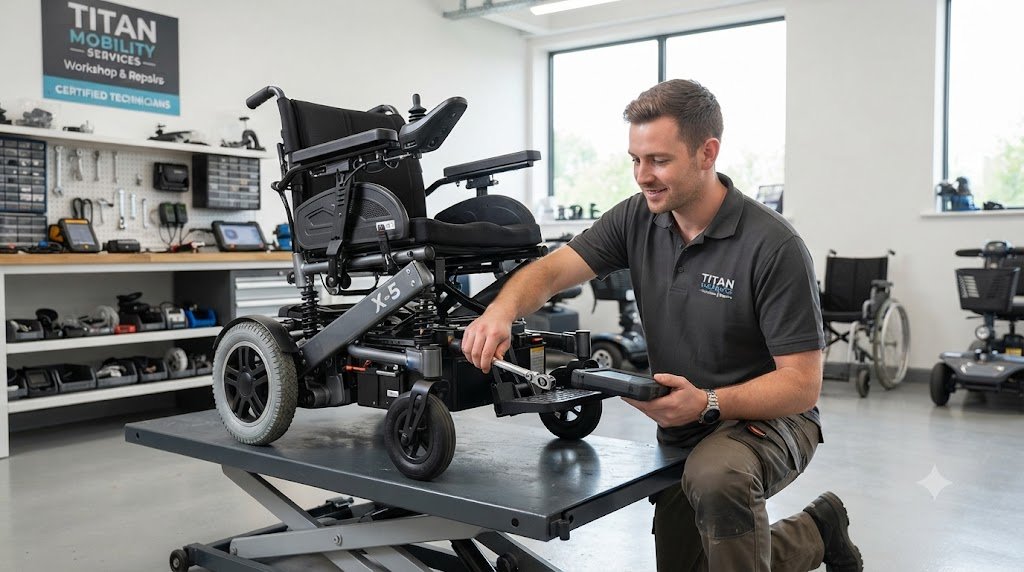
A battery-powered wheelchair generally needs more attention than a manual one, but most maintenance tasks are simple enough for a caregiver to handle at home, with occasional professional servicing.
Safety Considerations {#safety-considerations}
Wheelchair safety should never be an afterthought. Keep these factors in mind:
- Weight capacity – Confirm the chair supports the user’s weight with room to spare.
- Seat belts – Especially important for power wheelchair users with balance concerns.
- Brakes – Manual wheelchairs need reliable wheel locks; power wheelchairs need responsive electronic braking.
- Battery safety – Follow manufacturer charging guidelines to avoid overheating.
- Slopes – Know the maximum safe incline for your specific chair.
- Weather conditions – Rain and snow can affect traction and electronics on power wheelchairs.
- Regular inspections – Check tires, brakes, and frame integrity on a routine schedule.
Buying Guide {#buying-guide}
Before choosing between a manual or power wheelchair, think through these factors:
- User strength – Can the user safely self-propel, or is a motor necessary?
- Daily usage – Occasional use versus all-day use changes the priorities.
- Living environment – Narrow hallways, stairs, or tight bathrooms may favor a smaller manual chair.
- Transportation needs – Does the family have a vehicle that can carry a power wheelchair?
- Budget – Consider both upfront and long-term costs.
- Medical conditions – Some diagnoses make a power wheelchair medically necessary.
- Lifestyle – An active outdoor lifestyle often favors a power wheelchair.
- Storage space – Make sure there’s room to store and charge the chair at home.
Talking with an occupational therapist or physician can help match the right indoor wheelchair or outdoor wheelchair to the user’s specific needs before making a purchase.

Frequently Asked Questions {#faq}
1. Which wheelchair is best for seniors? It depends on strength and daily needs. Seniors with good upper body strength and occasional use often do well with a manual wheelchair, while those with limited strength or long-term needs usually benefit more from a power wheelchair.
2. Are power wheelchairs worth the cost? For users who need daily independence and struggle with manual mobility, a power wheelchair is often worth the investment, especially when it reduces caregiver strain and improves quality of life.
3. Can I travel with a power wheelchair? Yes, but it requires planning. Check the airline or cruise line’s policy on battery type, chair dimensions, and boarding assistance in advance.
4. Which wheelchair is easier to transport? Manual wheelchairs are far easier to transport since most fold flat and weigh much less than power wheelchairs.
5. Do power wheelchairs require maintenance? Yes. Power wheelchairs need regular charging, occasional motor servicing, and periodic checks on electronics and tires.
6. How long do wheelchair batteries last? Most power wheelchair batteries last 1 to 2 years with regular use before needing replacement, though this varies by model and charging habits.
7. Is a manual wheelchair good for everyday use? It can be, especially for users with sufficient strength or a caregiver who can assist. For all-day, every-day use, many people eventually find a power wheelchair more sustainable.
8. Can Medicare help pay for a wheelchair? Medicare may help cover part of the cost of a manual or power wheelchair if it’s considered medically necessary and prescribed by a doctor. Coverage details vary, so it’s best to check directly with Medicare or a supplier about specific eligibility.
9. Which wheelchair is best for outdoor use? Power wheelchairs generally perform better outdoors, especially on grass, gravel, and gentle slopes, thanks to their motorized power and larger wheels.
10. How do I choose the right wheelchair? Consider the user’s strength, daily routine, home layout, transportation needs, and budget. A conversation with a doctor or occupational therapist can help narrow down the best option.
11. Can a manual wheelchair be used outdoors? Yes, but it works best on flat, paved surfaces. Grass, gravel, and hills can be difficult to manage without help.
12. Do power wheelchairs work in small homes? Many power wheelchairs come in compact sizes designed for narrow hallways and doorways, but it’s important to measure your space before buying.
13. Is a self-propelled wheelchair hard to use? It takes some practice and upper body strength, but many users adjust quickly, especially with a lightweight frame.
14. What’s the difference between a transport wheelchair and a standard manual wheelchair? A transport wheelchair is lighter and meant to be pushed by a caregiver, while a standard manual wheelchair often includes larger wheels for self-propulsion.
15. How often should a power wheelchair be serviced? Most manufacturers recommend a professional check-up once or twice a year, in addition to routine at-home care.
Conclusion
It is clear that there are advantages with both manual and power wheelchairs, and it all depends on the personal strength, lifestyle, financial ability, and other factors of the patient.
For patients who require minimal assistance in their mobility and have strong physical health and the ability to push themselves, manual wheelchairs are recommended due to their affordability and portability.
Those who require full time assistance and have difficulties with moving due to weakness and chronic exhaustion can consider using power wheelchairs, which provide comfort and ease of mobility outdoors.
Before making a final choice, it is recommended to visit a doctor and receive a consultation from an occupational therapist.