
Staying active after 55 doesn’t require a gym membership or an intense workout plan. It starts with something much simpler: mobility. The ability to move your joints and muscles smoothly and comfortably affects almost everything you do in a day — walking to the mailbox, standing up from the couch, climbing a flight of stairs, or reaching for a plate on a high shelf.
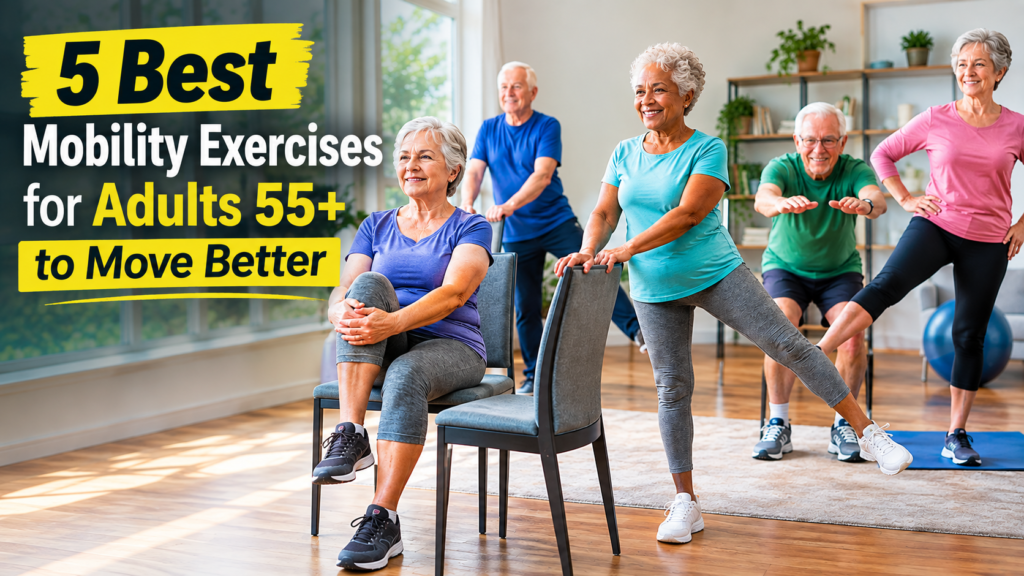
As we age, it’s normal for movement to feel a little less automatic than it used to. The good news is that mobility exercises for adults 55+ are one of the simplest, most accessible ways to support easier, more confident movement. They don’t require special equipment, they can be done at home, and they can be adapted to almost any fitness level.
This guide walks you through five beginner-friendly mobility exercises, how to do them safely, and practical tips to help you build a little more movement into your day — no matter where you’re starting from.
Table of Contents
- What Are Mobility Exercises?
- Why Mobility Matters After 55
- 5 Best Mobility Exercises for Adults 55+
- Warm-Up Before Mobility Exercises
- How Often Should Adults 55+ Do Mobility Exercises?
- Safety Tips
- When to Consider a Mobility Aid
- Frequently Asked Questions
- Conclusion
What Are Mobility Exercises?
Mobility exercises are movements designed to help your joints move through their natural range of motion with more ease and control. They’re often confused with flexibility, strength, or balance exercises, but each plays a slightly different role:
- Flexibility exercises (like stretching) focus on lengthening muscles.
- Strength exercises focus on building muscle power to support your body.
- Balance exercises focus on stability and reducing the risk of stumbling.
- Mobility exercises combine elements of all three, helping a joint — like your hip, knee, or ankle — move actively and comfortably through its full range.
In simple terms: flexibility is about how far you can stretch a muscle, while mobility is about how well you can actively move a joint on your own. Both matter, but mobility tends to have the biggest everyday impact because it’s tied directly to functional movement — the things you do dozens of times a day without thinking about them.
Why Mobility Matters After 55

Good mobility supports the kind of movement that makes daily life easier and more independent. Practicing gentle mobility exercises for adults 55+ can support:
- Easier everyday movement — bending, reaching, and turning with less effort
- Walking confidence — a steadier, more natural stride
- Flexibility — joints and muscles that feel less stiff, especially in the morning
- Balance — better control when shifting your weight or changing direction
- Joint movement — smoother motion in the hips, knees, and ankles
- Independence — more confidence doing daily tasks without assistance
It’s worth noting that mobility exercises are a supportive habit, not a guaranteed fix, and results vary from person to person. They work best as one part of an overall active lifestyle — alongside good nutrition, adequate rest, and regular movement throughout the day.
5 Best Mobility Exercises for Adults 55+
Each of these exercises is designed to be beginner-friendly, low-impact, and adaptable. You’ll only need a sturdy, stable chair (or a countertop for a couple of them) and a bit of open floor space.
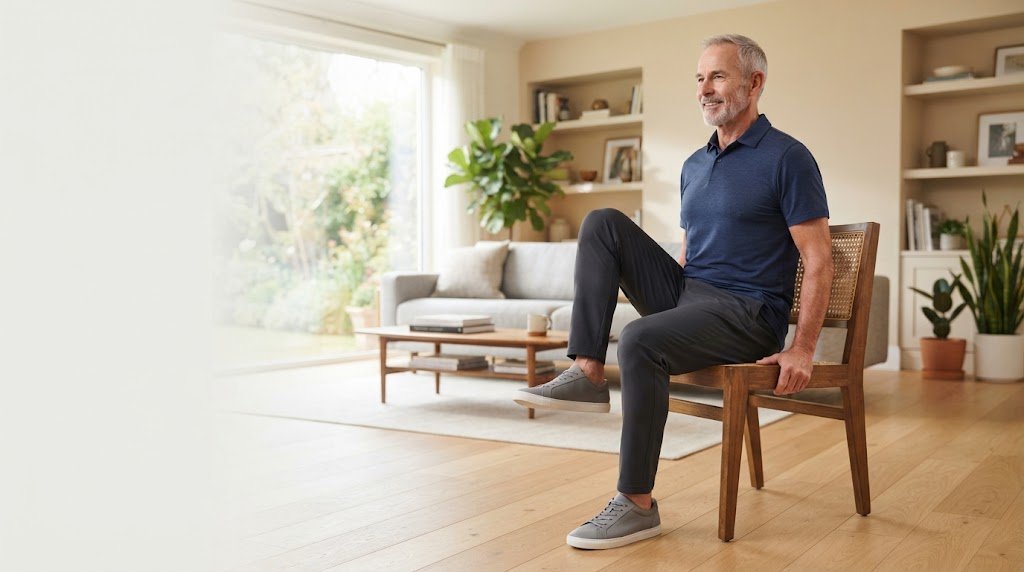
Exercise 1: Seated Knee Lifts
What it targets: Hip flexors and lower-body mobility
Seated knee lifts are a gentle way to warm up the hips and thighs without putting any weight through your legs.
How to do it:
- Sit tall toward the front of a sturdy chair with your feet flat on the floor.
- Keeping your back straight, slowly lift one knee a few inches off the seat.
- Hold for a moment, then lower it back down with control.
- Repeat on the other side.
Recommended reps: 8–10 lifts per leg, for 1–2 sets.
How to make it easier: Lift the knee only slightly, or reduce the number of repetitions.
Common mistakes: Leaning back or using momentum to swing the leg up instead of lifting with control.
Safety tip: Keep both hands resting lightly on the chair or your thighs for extra stability.
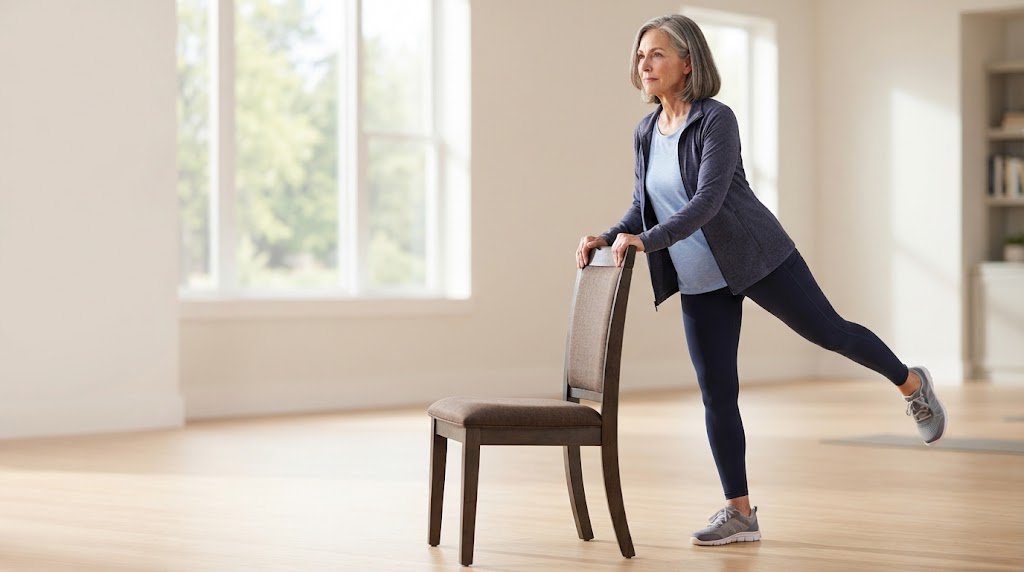
Exercise 2: Chair-Assisted Leg Raises
What it targets: Hip and thigh mobility, plus standing balance
This exercise builds on the seated version by adding a standing element, which can help translate mobility gains into everyday walking movement.
How to do it:
- Stand behind or beside a sturdy chair, holding the back or seat with one hand.
- Keeping your leg straight, slowly raise it a few inches forward or out to the side.
- Lower it back down with control.
- Complete a set, then switch sides.
Recommended reps: 8–10 raises per leg, for 1–2 sets.
How to make it easier: Raise the leg only a small distance off the floor, or perform the seated version instead.
Common mistakes: Rushing the movement or leaning the upper body to compensate.
Safety tip: Always keep one hand on the chair for support, and make sure the chair won’t slide.
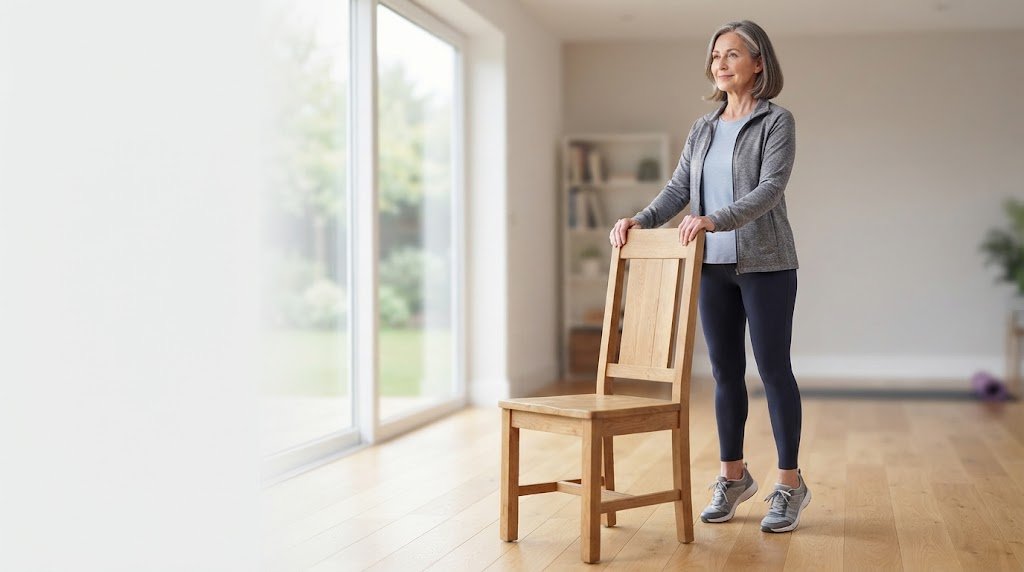
Exercise 3: Heel Raises
What it targets: Ankle mobility and calf strength, both important for walking
Heel raises help maintain ankle mobility, which plays a big role in a smooth, confident walking stride.
How to do it:
- Stand facing a sturdy chair or countertop, holding on with both hands.
- Slowly rise onto the balls of your feet, lifting your heels off the floor.
- Hold briefly, then lower your heels back down with control.
Recommended reps: 10–12 raises, for 1–2 sets.
How to make it easier: Rise onto your toes only slightly, or perform the movement with one foot slightly in front of the other for added stability.
Common mistakes: Rising too quickly or letting the heels drop down hard instead of lowering slowly.
Safety tip: Wear supportive, non-slip footwear rather than performing this barefoot on a slippery floor.
Exercise 4: Sit-to-Stand
What it targets: Hip and knee mobility, plus functional lower-body strength
Sit-to-stand is one of the most practical mobility exercises there is — it mimics a movement you already do many times a day.
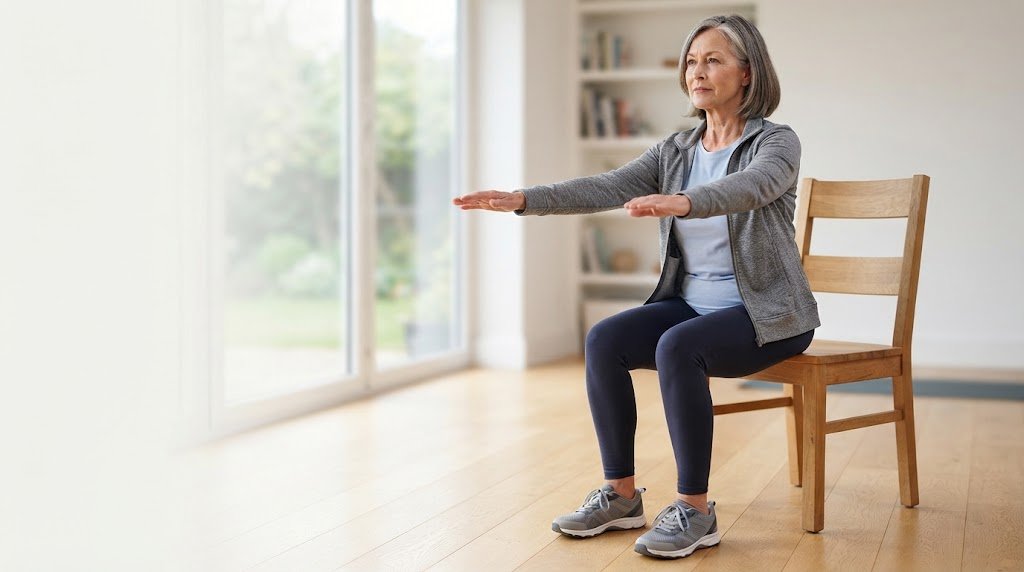
How to do it:
- Sit toward the front of a sturdy chair with feet flat on the floor, hip-width apart.
- Lean slightly forward and press through your feet to stand up slowly.
- Pause briefly once standing.
- Lower yourself back down slowly and with control, rather than dropping into the seat.
Recommended reps: 8–10 repetitions, for 1–2 sets.
How to make it easier: Use both hands to push off the chair arms or seat for extra support, or choose a slightly higher, firmer chair.
Common mistakes: Using momentum to “pop up” quickly instead of moving slowly and with control.
Safety tip: Make sure the chair is stable and won’t roll or slide before starting.
Exercise 5: Gentle Standing Hip or Side Leg Movements
What it targets: Hip mobility and lateral balance
This movement helps the hips move comfortably side to side, which supports balance and stability when walking on uneven surfaces or changing direction.

How to do it:
- Stand beside a sturdy chair or counter, holding on with one hand.
- Keeping your body upright, slowly move one leg out to the side a few inches.
- Bring it back to the center with control.
- Complete a set, then switch sides.
Recommended reps: 8–10 movements per leg, for 1–2 sets.
How to make it easier: Reduce the range of motion, or hold on with both hands facing the chair.
Common mistakes: Leaning the torso to the opposite side instead of keeping the upper body stable.
Safety tip: Keep movements small and controlled — this exercise is about control, not how far the leg moves.
Warm-Up Before Mobility Exercises
A short warm-up helps prepare your joints and muscles before moving into the exercises above. Try 3–5 minutes of the following:
- Gentle marching in place — lifting the knees slightly, at a comfortable pace
- Shoulder rolls — rolling the shoulders forward and backward a few times
- Ankle movements — rotating the ankles and gently flexing the feet
- Easy walking — a short, relaxed walk around the room
Starting slowly matters because it gives your body time to adjust, increases blood flow to the muscles, and helps you notice how your body is feeling before moving into more targeted exercises. If anything feels off during the warm-up, it’s a good signal to ease into the full routine more gradually.
How Often Should Adults 55+ Do Mobility Exercises?
For most adults 55+, doing mobility exercises 2–4 times per week is a reasonable starting point, though the right frequency varies from person to person. Some people prefer shorter sessions most days of the week, while others do a slightly longer routine two or three times a week.
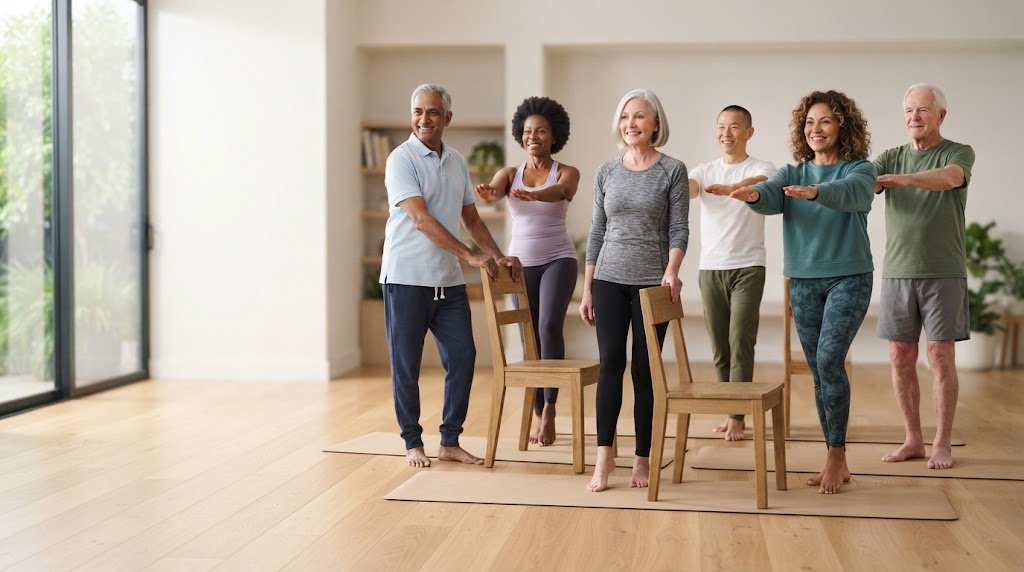
The most important factor isn’t intensity — it’s consistency. Gentle, regular movement tends to be more sustainable and beneficial over time than occasional, harder sessions. Starting with just 10–15 minutes a few times a week is a perfectly good place to begin, and you can build from there as it feels comfortable.
Safety Tips
Keeping mobility exercises safe helps you build a sustainable routine. Keep these general precautions in mind:
- Use a sturdy chair or stable surface whenever support is needed.
- Exercise in a clear, uncluttered area with enough space to move.
- Wear supportive, closed-toe footwear rather than exercising barefoot or in socks.
- Start slowly and increase repetitions gradually over time.
- Avoid sudden, jerky, or bouncing movements — smooth and controlled is the goal.
- Stop the exercise and rest if you experience pain, dizziness, chest discomfort, or unusual shortness of breath.
- Adults with significant balance problems, recent injuries, or existing medical conditions should check with a qualified healthcare professional about which exercises are appropriate for them.
When to Consider a Mobility Aid
For some adults, walking or balance can become more challenging over time, and that’s when a mobility aid may be worth considering. Choosing between a cane, walker, or rollator depends on individual needs — including balance, endurance, and the amount of support required — and is a decision best made with input from a qualified healthcare professional.

If you’re exploring your options, our Knowledge Center has more in-depth guides on how to choose between a cane, walker, and rollator, along with tips on using each one safely and confidently.
Frequently Asked Questions
1. What are the 5 best exercises for mobility? For adults 55+, a beginner-friendly starting set includes seated knee lifts, chair-assisted leg raises, heel raises, sit-to-stand, and gentle standing side leg movements. Together, they target the hips, knees, and ankles — the joints most involved in everyday movement.
2. Which exercise is best for mobility? There isn’t a single “best” exercise, since different movements target different joints. Sit-to-stand is often highlighted because it closely mirrors a movement used many times throughout the day, making it especially practical.
3. Can you improve mobility after 55? Many adults find that regular, gentle mobility exercises support easier movement over time. Individual results vary, and consistency matters more than intensity.
4. How often should adults 55+ do mobility exercises? A common starting point is 2–4 sessions per week, though this can vary based on personal comfort and goals. Regularity tends to matter more than how hard each session is.
5. What exercises help with walking and balance? Heel raises, sit-to-stand, and standing side leg movements are especially useful, since they involve the ankles, knees, and hips used during walking and changes in direction.
6. Can seniors do mobility exercises at home? Yes. All five exercises in this guide are designed to be done at home using just a sturdy chair, making them accessible without special equipment or a gym visit.

Conclusion
Improving mobility after 55 doesn’t have to be complicated. Seated knee lifts, chair-assisted leg raises, heel raises, sit-to-stand, and gentle standing side leg movements offer a simple, low-impact starting point that can be done from the comfort of home.
The goal isn’t to push hard or move quickly — it’s to move safely, consistently, and with control. Over time, small, steady efforts can add up to more confident, comfortable movement in everyday life.
Every step toward better mobility is a step toward greater independence. Start where you are, move at your own pace, and build from there.