

Table of Contents
- Introduction
- What Is a Cane?
- What Is a Walker?
- Canes vs Walkers: Quick Comparison Table
- Key Differences Between Canes and Walkers
- When Should You Choose a Cane?
- When Should You Choose a Walker?
- Pros and Cons
- Safety Tips
- Can You Transition from a Cane to a Walker?
- Frequently Asked Questions
- Conclusion
Introduction
Selecting the right walking aid is an important decision for seniors and their caregivers. The right mobility aid can improve confidence, safety, and independence, while the wrong choice may increase the risk of falls or injuries. That’s why many people compare Canes vs Walkers to determine which option best meets their mobility needs.
When comparing Canes vs Walkers, it’s important to understand that both devices are designed to improve mobility but serve different purposes. A cane provides extra support for individuals with mild balance or stability issues, while a walker offers greater support for those who need enhanced stability and weight-bearing assistance. Understanding these differences is the first step in making an informed mobility aid comparison.
Every year, many older adults ask the same question: Canes vs Walkers—which is the better choice? The answer depends on a person’s health condition, balance, strength, mobility level, and daily activities. Choosing the right mobility aid can improve safety and independence, while selecting the wrong one may lead to discomfort, reduced mobility, or an increased risk of falls.
In this article, you will find out:
- Basic differences between a walking cane and walker
- For whom each of the devices is suitable
- How to determine your own mobility needs
- Safety tips while using a mobility aid
- When it’s necessary to switch from one aid to another
This article will be helpful for both seniors and caregivers.
What Is a Cane?
A cane is a lightweight, handheld mobility device that provides a single point of contact with the ground. It’s one of the most common assistive walking devices used by seniors who need minor to moderate support with balance or weight-bearing.

How It Works
A cane is held on the stronger side of the body and used to redistribute weight, reduce pressure on a weaker leg or joint, and improve balance while walking. It works best for people who are already relatively stable but want extra reassurance and support.
Types of Canes
- Standard cane – A simple, single-tip cane ideal for mild balance concerns.
- Quad cane – Features four small feet at the base for extra stability, often used after a stroke or injury.
- Folding cane – Compact and portable, great for travel or occasional use.
- Offset cane – Designed with a curved shaft to better align body weight over the base, reducing strain on the wrist.
Advantages
- Lightweight and easy to carry
- Affordable and widely available
- Allows for a more natural walking gait
- Great for outdoor use and uneven terrain
- Minimal learning curve
Limitations
- Provides less stability than a walker
- Not suitable for significant weight-bearing needs
- May not be enough support for people with severe balance issues
Who Benefits Most from a Cane for Seniors
A cane for seniors is ideal for those with mild joint pain, minor muscle weakness, or slight balance concerns who are still largely independent and mobile. It’s often recommended for people recovering from minor injuries or living with manageable arthritis symptoms.
What Is a Walker?
A walker is a four-legged mobility frame that offers a wider base of support than a cane. It is one of the most reliable elderly walking aid options for individuals who need more substantial assistance with balance and weight distribution.

How It Works
Users hold onto the walker’s handles and move it slightly forward with each step, using it to support a larger portion of their body weight. This makes walkers especially useful for people with significant strength or balance limitations.
Types of Walkers
- Standard walker – No wheels; requires lifting slightly with each step, offering maximum stability.
- Two-wheel walker – Front wheels allow for smoother movement while still offering strong support.
- Rollator walker – Four wheels, hand brakes, and often a built-in seat, ideal for those who can walk but need occasional rest.
- Upright walker – Designed to promote better posture, often preferred by users with back or hip concerns.
Advantages
- Offers maximum stability among mobility equipment for seniors
- Supports a greater portion of body weight
- Reduces fall risk for those with significant mobility challenges
- Many models include storage baskets or seats
- Ideal for indoor and outdoor use
Limitations
- Bulkier and harder to transport than a cane
- Can be more difficult to maneuver in tight spaces
- Requires more upper body strength to operate certain models
Who Benefits Most from a Walker for Seniors
A walker for seniors is typically recommended for individuals recovering from surgery, managing a chronic condition like Parkinson’s disease, or facing a higher risk of falling. It’s also a strong option for those who feel unsteady even with a cane
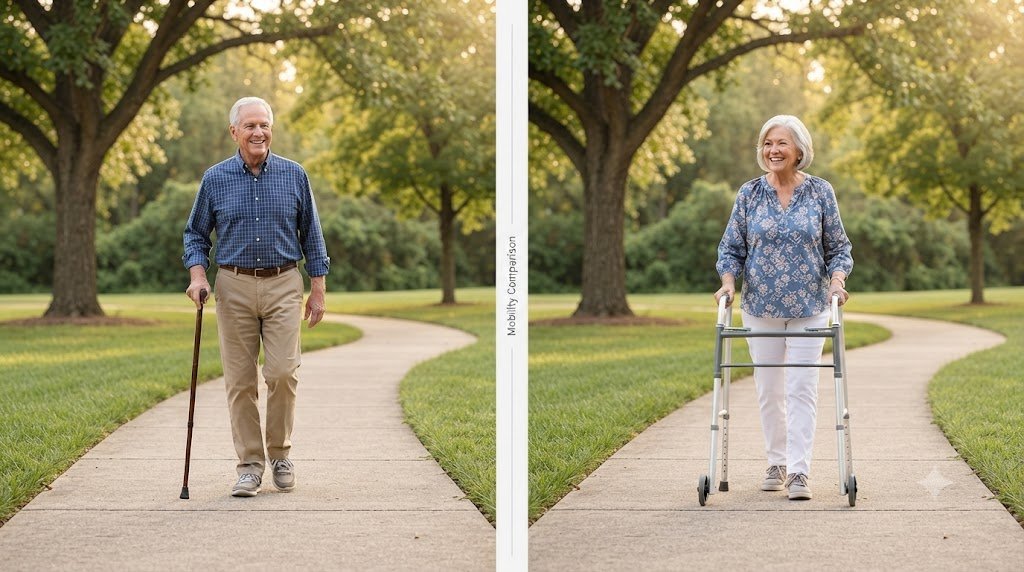
Canes vs Walkers: Quick Comparison Table
| Feature | Cane | Walker |
| Stability | Moderate | Hugh |
| Balance Assistance | Light Support | trong support |
| Weight Support | Limited (up to ~25% | Substantial (up to ~50% |
| Ease of Use | Very Easy | Requires practice |
| Indoor Use | Good | Excellent |
| Outdoor Use | Excellent | Good, but bulkier |
| Portability | Highly Portable | Less portable |
| Speed | Faster, natural gait | Slower, more deliberate |
| Cost | Lower | Higher |
| Fall Prevention | Moderate | High |
| Best For | Mild balance issues | Significant mobility needs |
Key Differences Between Canes and Walkers
When discussing the difference between a cane vs walker, there are several important aspects to consider.
Stability During Walking: Walkers have a broader basis, which means that they provide more stability than canes. It is especially valuable for people at a higher risk of falling.
Balance Assistance: The canes give a certain balance assistance, while walkers give support to the whole body from both sides.
Weight Bearing Ability: With a cane, one can put some weight on it, while a walker can bear a significantly bigger portion of the body’s weight.
Freedom of Movement: Canes let one move quite freely, while walkers need a certain pattern.
Portability: Canes are portable and can be easily folded and transported. Walkers, in turn, are bulkier and do not fit in cars.
Storage: Rollator walkers have storage features such as baskets or pouches for carrying things. Canes do not have such a feature.
Training Time: The use of canes does not require any training. Two-wheel or regular walkers may need some time to master.
Fall Protection: As walkers have more contact surface, their users fall less often, especially when compared to those using canes.
Long-Term Use: There are people who use canes long-term for chronic, mild conditions. There are also those who switch to walkers due to an increasing necessity for support over time.
Daily Activity: Both the mentioned tools help people become independent in everyday activities, depending on how much support one needs physically.
When Should You Choose a Cane?
A cane may be the right walking support device if you experience:
- Mild balance problems that don’t significantly affect daily activities
- Arthritis causing occasional joint discomfort
- Minor leg weakness on one side
- An active lifestyle that includes walking outdoors or traveling
- The need for outdoor mobility on trails, sidewalks, or uneven ground
- A temporary injury that requires light support during recovery
If you’re mostly steady on your feet but want extra reassurance, a cane is often the simplest and most practical solution.
When Should You Choose a Walker?
A walker may be a better fit if you are dealing with:
- Recovery from surgery, such as hip or knee replacement
- Stroke rehabilitation requiring significant balance support
- Parkinson’s disease or other neurological conditions affecting gait
- Significant muscle weakness in the legs or core
- A history of falls or a high fall risk
- The need for long-term mobility support in daily life
For individuals with more advanced mobility challenges, a walker provides the stability while walking that a cane simply cannot match.
Pros and Cons
Pros of Canes
- Lightweight and portable
- Affordable
- Encourages a natural walking gait
- Great for outdoor terrain
- Minimal learning curve
Cons of Canes
- Limited weight-bearing support
- Less stability for those with significant balance issues
- Not ideal for severe mobility limitations
Pros of Walkers
- Maximum stability and support
- Reduces fall risk significantly
- Many models include seats and storage
- Suitable for a wide range of mobility challenges
Cons of Walkers
- Bulkier and harder to transport
- Can be challenging in tight spaces
- Requires more upper body strength and coordination
Safety Tips

Whether you choose a cane or a walker, proper use is essential for fall prevention for seniors.
- Proper height adjustment: The device should allow your elbow to bend slightly (about 15-20 degrees) when holding the handle.
- Correct walking technique: Move the cane or walker forward first, followed by the weaker leg, then the stronger leg.
- Supportive footwear: Wear non-slip, well-fitted shoes rather than slippers or sandals.
- Rubber tip inspection: Check cane and walker tips regularly for wear and replace them if they become smooth or cracked.
- Walker maintenance: Ensure wheels roll smoothly and brakes (on rollators) function properly.
- Avoiding slippery surfaces: Be extra cautious on wet floors, icy sidewalks, or freshly mopped areas.
- Professional fitting: A physical therapist or doctor can help determine the correct height and type of device.
- Fall prevention strategies: Keep walkways clear of clutter, use good lighting, and consider grab bars in bathrooms.
Can You Transition from a Cane to a Walker?
Yes, and for many seniors, this transition is a normal part of aging or recovering from a health event. Watch for these signs that more support may be needed:
- Increased unsteadiness or near-falls, even while using a cane
- New diagnoses affecting strength or coordination
- Reduced confidence walking longer distances
- A recent fall or hospitalization
Consulting healthcare professionals — such as a physician or physical therapist — is the best way to determine whether it’s time to upgrade to a safer mobility aid. They can assess strength, balance, and gait to recommend the right next step.
Frequently Asked Questions
Is a walker safer than a cane? For individuals with significant balance or strength limitations, a walker generally offers more safety due to its wider base of support and greater weight-bearing capacity.
Who should use a cane instead of a walker? People with mild balance issues, minor joint pain, or those who remain largely independent and active typically do well with a cane.
Can I use a cane after knee replacement? Many patients use a walker immediately after surgery, then transition to a cane as strength and balance improve, based on guidance from their surgeon or physical therapist.
Does Medicare cover canes and walkers? Medicare Part B may cover canes and walkers as durable medical equipment when prescribed by a doctor, though coverage details vary, so it’s best to confirm with your specific plan.
Which is easier to travel with? Canes are generally easier to travel with due to their compact, foldable design, though lightweight travel walkers are also available.
Can a walker improve balance? Yes, a walker can significantly improve balance by offering a wider, more stable base of support compared to walking without assistance or with a cane alone.
How do I know when I need a walker? If you experience frequent unsteadiness, have had a recent fall, or feel a cane no longer provides enough support, it may be time to consider a walker.
Can I switch from a cane to a walker? Absolutely. Many seniors transition between devices as their mobility needs change, and healthcare providers can help guide this decision safely.
Conclusion
With regards to canes and walkers, there is no one-size-fits-all solution to the issue of what to choose. It all depends on individual balance, strength, and mobility factors. Canes are great lightweight devices that are perfect for people who experience slight issues with their balance, while walkers are meant for those who require increased stability.
The choice of a proper mobility assistance tool will not only be convenient but also safe and give you peace of mind. It will enable you to live an active life despite any physical difficulties that you have.
To make the right choice, it is recommended to seek medical advice from a doctor or a physical therapist.
Thanks to my father who shared with me regarding this web site, this weblog
is in fact awesome.