
Introduction
As soon as you start questioning your own balance, your everyday routine will get transformed somehow. You may now prefer even ground rather than pavements with cracks, grab hold of any piece of furniture, or feel afraid while going up or down the stairs. Luckily, there is an easy solution for millions of older patients in the U.S. – to use a quad cane.
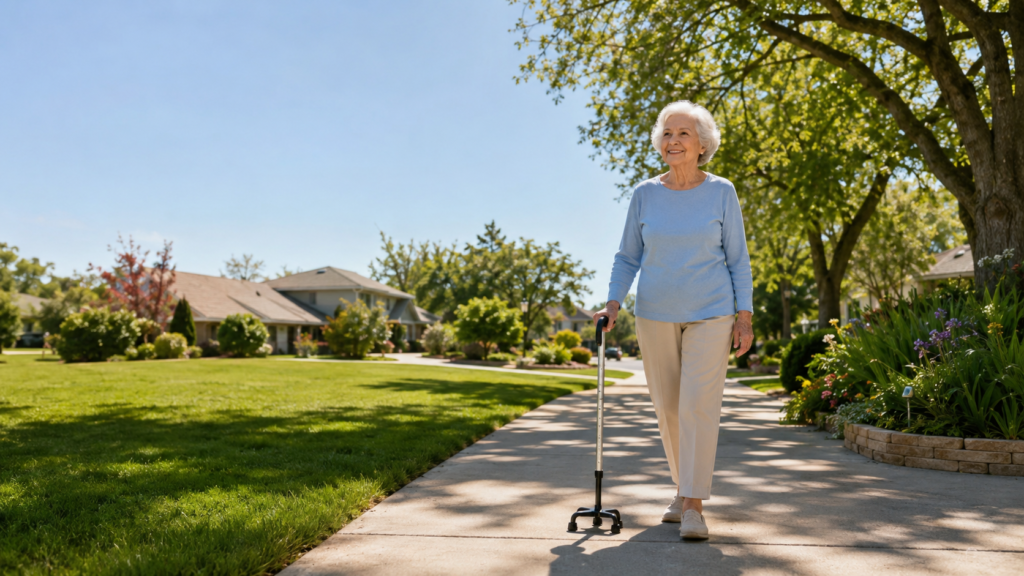
Although a traditional cane features one tip only at the bottom, a quad cane features four points, which provide extra stability without adding unnecessary bulkiness in comparison with a walker. Being one of the most commonly used assistive devices for elderly patients, it serves as a good middle ground between independence and safety.
In this article, we will consider what a quad cane is, how it works, who can benefit the most from using such a device, and how to use it properly in the context of fall prevention among seniors.
Please keep in mind that this article is informative only. Consult your doctor before choosing a suitable mobility device as he/she knows best which one is the most appropriate for you.
What is a Quad Cane?
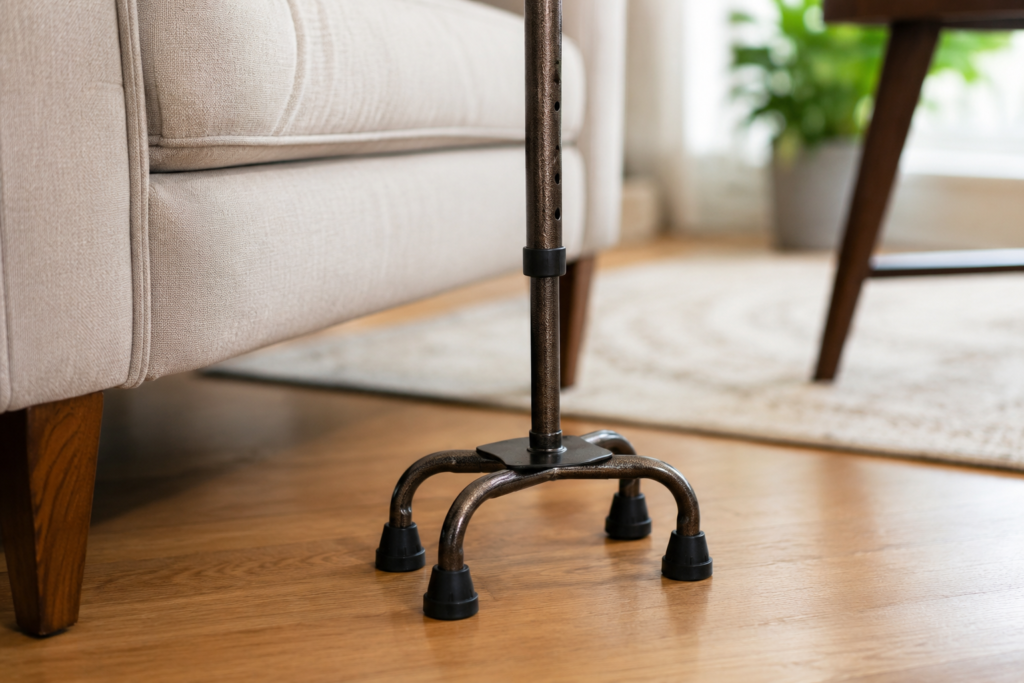
A quad cane is an assistive device with four feet at its base in the shape of a rectangle or square. The quad cane differs from the regular cane in that it has several points of contact on the ground instead of one point.
There are two types of quad canes with different bases:
A quad cane with a small base – it is lightweight and easier to operate; it is designed for indoor use.
A quad cane with a large base – it gives more stability and is advised for patients with balance disorders.
Quad canes provide extra support and thus belong to senior mobility devices.
How Does It Work?
The quad cane operates by spreading body weight over four points of contact with the ground as opposed to just one. The increased surface area means that the cane is less likely to topple to either side compared to canes that use only one point of contact.
When used properly, the quad cane should be grasped on the stronger side of the body and will move along with the foot that takes a step forward, offering additional support as needed.
Physiotherapists usually recommend certain techniques for stepping while using a quad cane, which makes this an important part of overall balance training.
Key Features
Quad canes come with a range of features designed to improve comfort, safety, and ease of use:
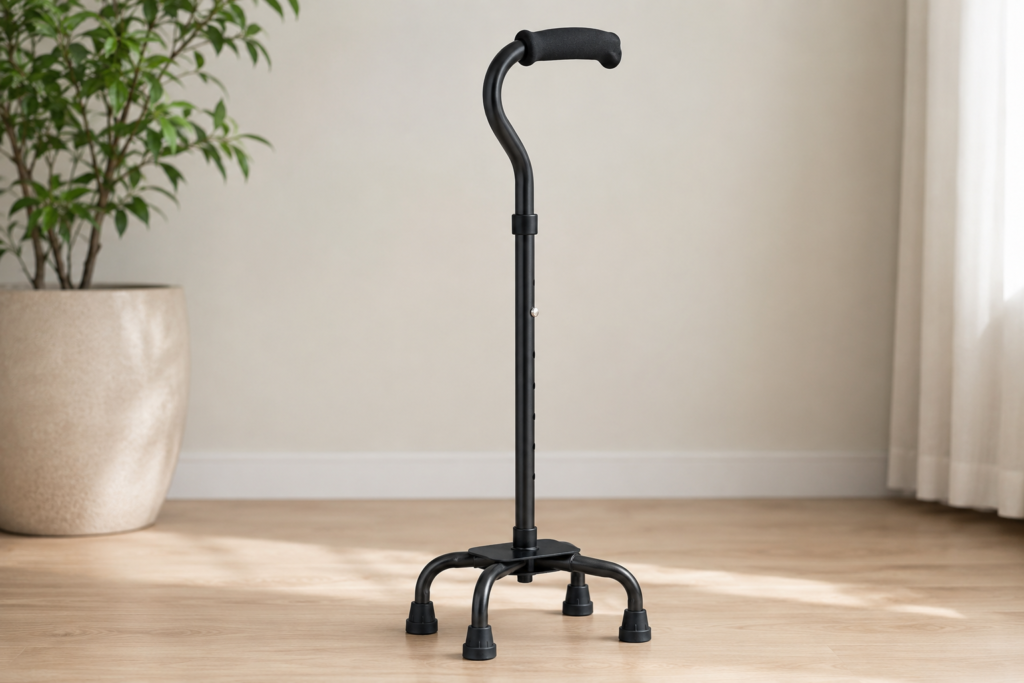
- Four-point base for added stability compared to single-tip canes
- Adjustable height settings, usually via a push-button mechanism
- Ergonomic handles, including offset and contoured grips for wrist comfort
- Lightweight aluminum construction for easy handling
- Non-slip rubber tips on each of the four feet
- Left- or right-hand designs, depending on which side needs support
- Folding options available for easier transport and storage
These features make quad canes a practical choice among daily living aids for seniors who want reliable support without sacrificing mobility.
What are Types of Quad Cane?
Here are some common types of quad cane you could find:
- Small Base Quad Cane – Small and light; great for those requiring some support and more mobility around the house.
- Large Base Quad Cane – Provides a larger and steadier surface; best for those with more obvious balancing issues.
- Offset Quad Cane – The handle is set in such a way that the weight of your body comes directly on the base of the cane.
- Adjustable Height Quad Cane – Can be customized to ensure the right fit, which is crucial for posture.
Benefits
There are many benefits associated with the use of quad canes for senior citizens looking to stay independent:
- Greater stability than single tip canes in general, and particularly on uneven surfaces
- Falling risk is lowered when used properly and regularly
- Helps weak or injured limbs that require support after surgery, strokes, or injuries
- Can stand independently in contrast to traditional canes, making it handy for breaks
- Helps the senior remain mobile and not sedentary by encouraging mobility
- Facilitates independent living for seniors by enabling them to move without relying on anyone
Who Can Benefit?
Some groups of people for whom quad canes may be suggested include:

- Senior citizens having problems with their balance
- People after hip or knee surgery
- Arthritis patients suffering from joint pain
- Stroke patients having strength problems in one side of the body
- Senior citizens having trouble balancing when going up and down stairs, on rough pavements, or in crowded areas
- People whose doctor or physiotherapist recommends extra help while walking
Since arthritis causes pain in the hands which makes it difficult for people to hold objects or walk around, the topic of quad canes for arthritis is often discussed.
Pros and Cons Comparison Table
| Aspect | Quad Cane | Standard Cane | Walker |
| Stability | Moderate to high | Lower | Highest |
| Portability | Easy to carry | Very easy to carr | Bulkier |
| Best for | Mild-moderate imbalance | Minimal support needs | Significant balance issues |
| Can stand alone | Yes | No | Yes |
| Indoor use | Excellent | Excellent | Can be difficult in small spaces |
Possible Limitations
Even though quad canes have an important role to play, they might not be suitable for everybody:

- They need more coordination to use than a regular cane.
- It might be bulkier and could trip on carpets and other non-smooth surfaces.
- It is designed to work with only one side of the body.
- Using it improperly could mean that it would lose its efficiency and even pose a fall risk.
If the patient is experiencing more serious balance problems, the healthcare practitioner might recommend using a walker.
Everyday Uses
Quad canes are versatile in nature and are adaptable in all kinds of everyday situations, like:
- Walking inside as well as outside
- Grocery shopping
- Stair climbing (properly and usually step-by-step)
- Going to doctor’s appointments
- Exercise walking
- Getting into and out of vehicles
Safety Tips
In order to get the maximum benefit out of your quad cane, here are some safety tips that you should bear in mind:
- Ensure proper fitting of the cane so that there is a little bend in your elbow while holding it.
- Use the cane on the side of the body which is stronger and on the opposite side of the weak leg.
- Take a step of the weak leg after moving the cane along with it and move the strong leg forward.
- Replace the rubber tips whenever necessary.
- Do not use it on icy or slippery surfaces.
- Discuss the correct technique with a physiotherapist.
- Use your cane with modifications at your home to reduce falls among senior patients.
Maintenance and Care
Routine maintenance helps keep a quad cane safe and reliable:
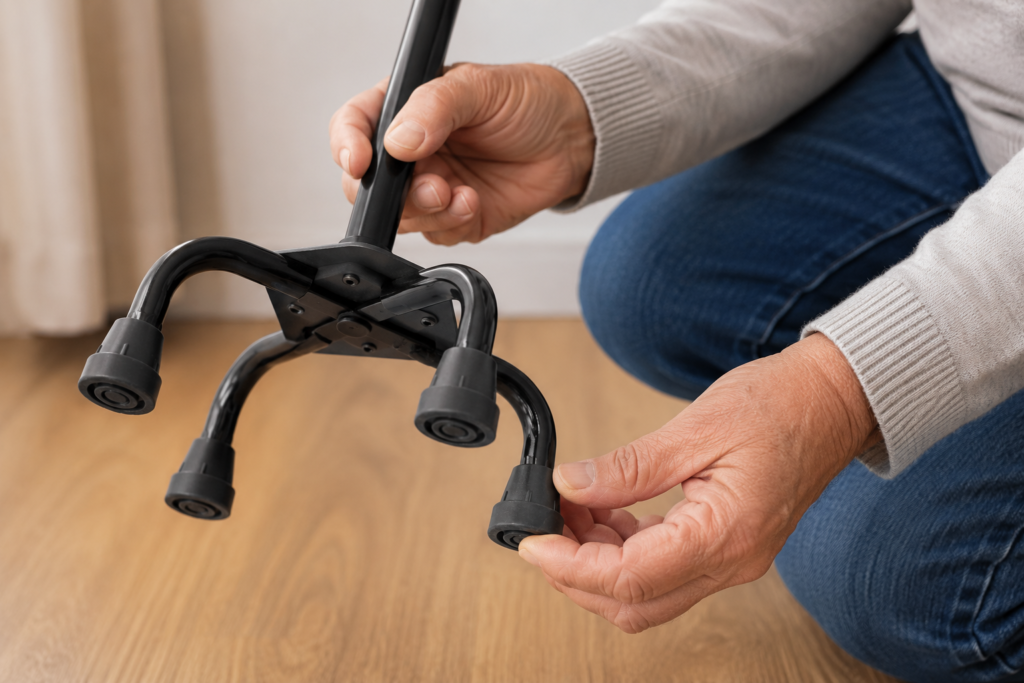
- Inspect the four rubber tips monthly for cracks or smooth, worn spots
- Tighten any loose height-adjustment mechanisms
- Wipe down the handle and shaft with a damp cloth to remove dirt or grip residue
- Store the cane upright in a dry area
- Check for bent or damaged legs, especially after any drop or impact
Frequently Asked Questions
- How does a quad cane differ from a traditional cane?
A quad cane has four legs instead of one, which provides more stability and balance compared to a traditional cane. - Can a quad cane stay upright?
Yes, most quad canes have the capability of remaining upright by themselves, a convenient feature to have. - Which side do I use for a quad cane?
Quad canes should usually be held by their owner’s dominant side to provide maximum support to the other side. - Does quad cane help with arthritis?
People with arthritis find quad canes quite useful, particularly quad canes equipped with an ergonomic handle. - When would I need a quad cane rather than a regular cane?
A person would require a quad cane when he feels unstable while using a regular cane. He could consult his doctor or physical therapist about it. - Can a quad cane be used while going up or down stairs?
Yes, but it involves some special technique and it is recommended that you receive some assistance from a physical therapist.
Conclusion
A quad cane can be a valuable tool for choosing the right mobility aid when balance concerns start to affect daily confidence. With its wider base and added stability, it offers meaningful support for many seniors managing arthritis, recovering from injury, or simply looking to stay steady on their feet.
As with any mobility device, the best results come from proper fitting, correct technique, and guidance from a healthcare professional. When used thoughtfully, a quad cane can help support senior independence while reducing the risk of falls.
Related Articles
- Standard Canes: When Simplicity Is All You Need
- Folding Canes: Convenient Support for Life on the Go
- Adjustable Canes: Finding the Right Fit for Your Height
- Rollators vs. Walkers: Which Offers More Support?
- Fall Prevention Tips for Aging in Place