
Table of Contents
- Introduction
- What Is an Upright Rollator?
- How Does an Upright Rollator Work?
- Who Can Benefit from an Upright Rollator?
- Benefits of Upright Rollators
- Potential Drawbacks
- Key Features to Look For
- Upright Rollator vs. Traditional Rollator
- How to Choose the Right Upright Rollator
- Safety Tips
- Maintenance and Care
- Frequently Asked Questions
- Conclusion
Introduction
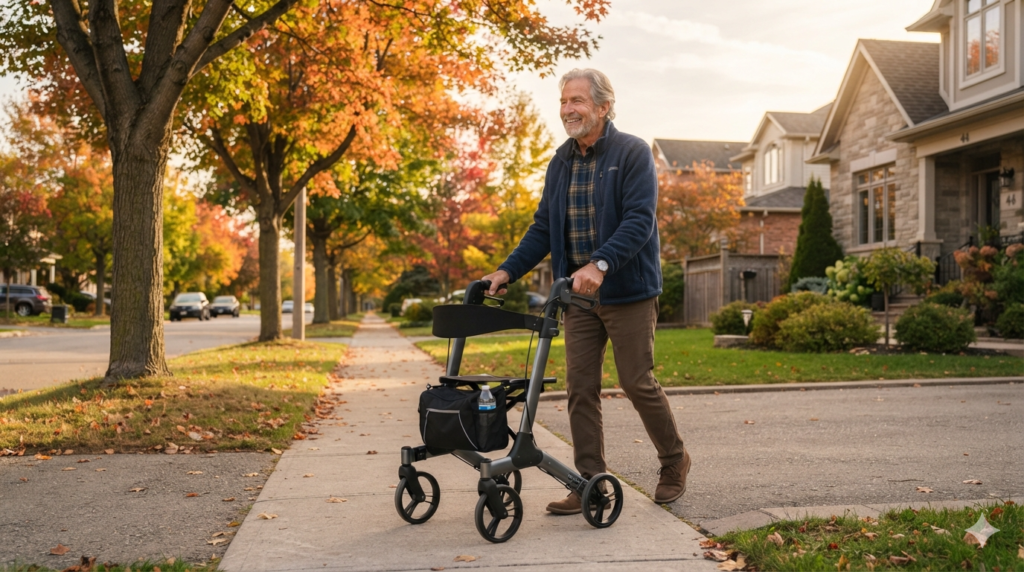
If you’ve ever watched someone hunch over a traditional walker, you’ve probably noticed how it changes their whole posture. The shoulders round forward, the head drops, and every step looks like a bit of a struggle. That’s one of the main reasons upright rollators have become such a popular option among seniors and caregivers alike.
Unlike standard rollator walkers, an upright rollator lets the user stand tall while walking, which can make a real difference in comfort, confidence, and overall quality of life. In this guide, we’ll walk through exactly what an upright rollator is, who it’s designed for, and how to pick the right one.
What Is an Upright Rollator?
An upright rollator, sometimes called an upright walker or posture walker, is a wheeled mobility aid designed to support the body in a naturally standing position. Instead of leaning forward onto low handles, the user rests their forearms on padded, elevated supports.
This design encourages a more natural spine alignment, which is why many people also call it a forearm support walker. It’s part of the broader family of mobility aids, but it stands apart because of how it changes the user’s posture while moving.
How Does an Upright Rollator Work?
The forearm supports are usually adjustable in height, allowing the user to find a position where their elbows rest comfortably at roughly a 90-degree angle. This shifts weight distribution away from the wrists and lower back.
Most models include:
- Four wheels for smooth movement
- Hand brakes for controlled stopping
- A padded seat for resting
- A basket or storage pouch for essentials
Because the frame supports the forearms rather than just the hands, users often find it easier to walk longer distances without tiring as quickly.
Who Can Benefit from an Upright Rollator?
An upright rollator isn’t just for one type of person. It tends to help:
- Seniors with mild to moderate balance concerns
- People recovering from hip or knee surgery
- Those with arthritis in the hands or wrists
- Individuals with mild spinal curvature or posture-related discomfort
- Caregivers looking for a safer walking aid alternative to a standard walking cane
If someone finds a traditional walker uncomfortable on their wrists or shoulders, an upright model is often worth exploring with their doctor or physical therapist.
Benefits of Upright Rollators
| Benefit | Why It Matters |
|---|---|
| Improved posture | Reduces forward-leaning strain on the back and neck |
| Better weight distribution | Forearm support reduces pressure on wrists and hands |
| Increased confidence | Standing tall while walking can feel more natural and dignified |
| Enhanced visibility | Users see their surroundings more clearly, which supports safer navigation |
| Comfortable long-distance use | Less fatigue during errands or walks in the park |
Potential Drawbacks
No mobility aid is perfect for everyone. Some things to keep in mind:
| Drawback | Consideration |
|---|---|
| Larger frame | Can be harder to store or fit through narrow doorways |
| Heavier | May be more difficult to lift into a car trunk |
| Learning curve | Takes a few days to get used to the different arm positioning |
| Higher price point | Often costs more than a standard walker |
Key Features to Look For
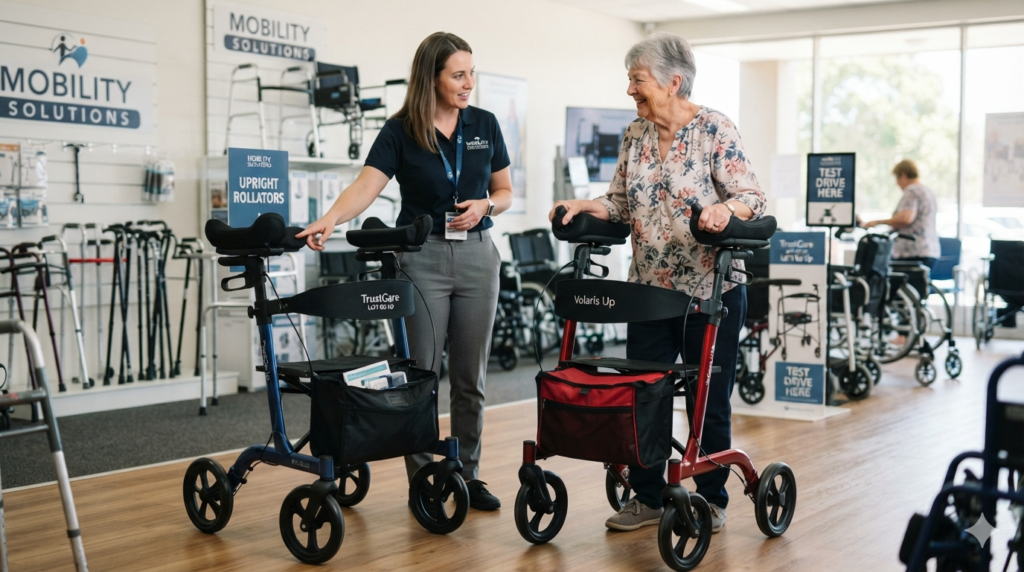
When shopping, pay attention to:
- Adjustable forearm height – should fit the user’s arm length precisely
- Wheel size – larger wheels handle uneven sidewalks and outdoor terrain better
- Weight capacity – check the manufacturer’s listed limit
- Foldability – important for storage and transport in a car
- Braking system – look for easy-to-reach, responsive hand brakes
- Seat comfort – a padded, stable seat is useful for rest stops
Upright Rollator vs. Traditional Rollator
| Feature | Upright Rollator | Traditional Rollator |
|---|---|---|
| Posture support | Encourages upright stance | Often requires forward lean |
| Hand/wrist pressure | Lower, due to forearm support | Higher, weight rests on hands |
| Frame size | Generally larger | More compact |
| Best for | Posture or joint concerns | General mobility support |
| Price range | Typically higher | Typically lower |
Both styles are valid options — the right choice depends on the individual’s specific needs, which a physical therapist can help assess.
How to Choose the Right Upright Rollator
Think through these questions before buying:
- Will it be used mostly indoors, outdoors, or both?
- Does the user need a seat for resting during walks?
- How much storage space is available at home?
- Will it need to fit in a car regularly?
- Is a lightweight frame a priority for the caregiver lifting it?
If mobility needs change over time, it may also be worth comparing options like manual wheelchairs, electric wheelchairs, transport wheelchairs, or mobility scooters for longer-term planning. A lift chair can also complement an upright rollator nicely at home, especially for those who need help standing up from a seated position.
Safety Tips
- Always lock the brakes before sitting on the seat
- Check tire pressure and wheel alignment regularly
- Keep walking paths clear of clutter and cords
- Have a caregiver or physical therapist confirm the correct forearm height
- Avoid using the rollator on wet or icy surfaces when possible
Maintenance and Care
A little routine care goes a long way:
- Wipe down handles and armrests weekly
- Check brake cables every few months for wear
- Tighten any loose bolts or screws periodically
- Store indoors when not in use to prevent wheel damage
- Replace worn tires or brake pads promptly
Frequently Asked Questions
1. Is an upright rollator covered by Medicare? Coverage varies. It’s best to check with Medicare or a supplemental insurance provider directly, since coverage depends on medical necessity documentation from a doctor.
2. Can an upright rollator help with back pain? Many users report improved comfort due to better posture, but it’s not a guaranteed treatment. Speak with a doctor or physical therapist about your specific condition.
3. Are upright rollators harder to use than traditional ones? There’s often a short adjustment period, but most users adapt within a few days of practice.
4. What’s the average price of an upright rollator? Prices vary by brand and features, generally ranging from moderate to premium compared to standard walkers.
5. Can I use an upright rollator outdoors? Yes, most models are designed with larger wheels suited for sidewalks, parks, and mild outdoor terrain.
6. Do upright rollators fold for storage? Many models fold, though the mechanism and final folded size vary by manufacturer.
7. Is a prescription needed to buy one? Not always for retail purchase, but insurance reimbursement often requires a doctor’s prescription.
8. How do I know if my forearm height is set correctly? Elbows should rest at approximately a 90-degree angle without shrugging the shoulders. A physical therapist can help fine-tune this.
Conclusion

Choosing the right mobility aid is a personal decision, and an upright rollator can be a great fit for those who want better posture support and added comfort during daily walks. As with any mobility decision, it’s worth consulting a doctor or physical therapist to confirm it matches individual needs.
Whether you’re a senior exploring options for yourself or a caregiver helping a loved one, taking time to compare features — and trying a model in person when possible — can make all the difference in finding the right walking companion. For more guidance, check out our full Walker Buying Guide.
Internal Linking Suggestions Used
- Rollator Walkers
- Standard Walkers
- Walking Canes
- Manual Wheelchairs
- Electric Wheelchairs
- Transport Wheelchairs
- Mobility Scooters
- Lift Chairs
- Walker Buying Guide